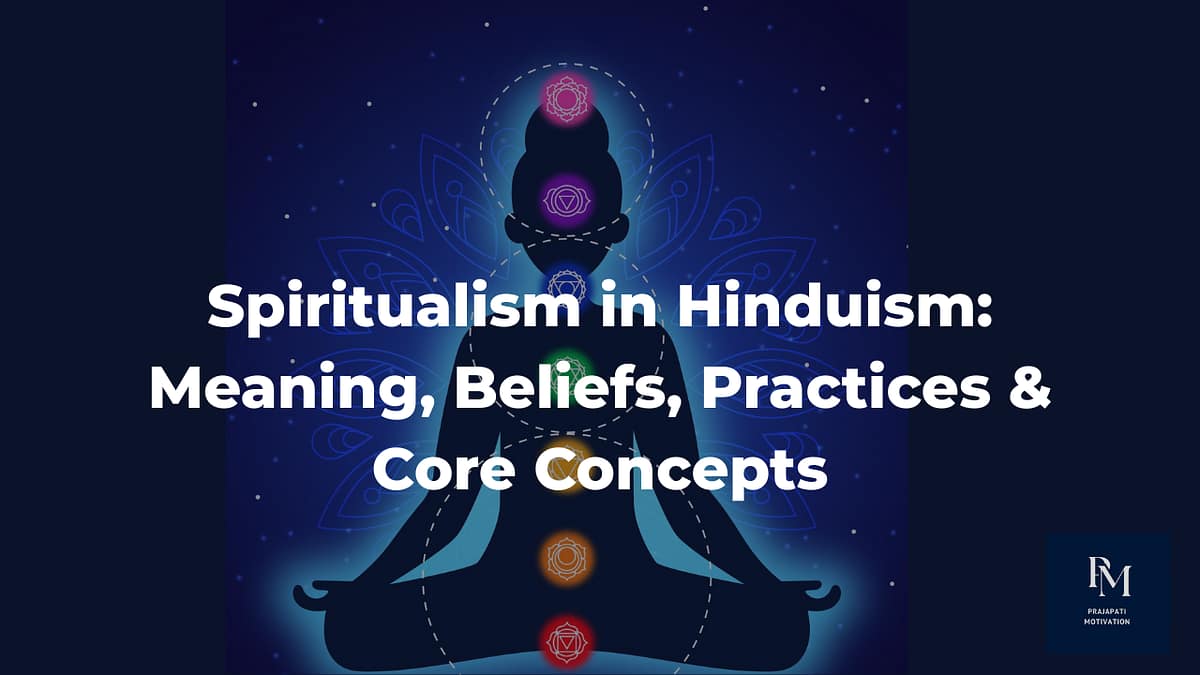
Spiritualism in Hinduism is not merely a set of beliefs — it is a lived path. Rooted in ancient scriptures and refined by generations of teachers, Hindu spiritualism teaches how to know the self, live with dharma (right conduct), and awaken to the ultimate reality (Brahman). This article explains the core ideas simply, with practical steps you can apply every day.
1. What is Spiritualism in Hinduism?
At its heart, spiritualism in Hinduism is the search for truth about the Self (Ātman) and its relationship with the Absolute (Brahman). It emphasizes inner transformation over outer accumulation. Where materialism seeks comfort in external things, Hindu spiritualism points inward: quieting the senses, purifying the mind, and realizing the eternal nature of the soul.
Key summary:
- Spiritualism → realization of inner truth, ethical living, and liberation (moksha).
- Goal → freedom from the repeating cycle of birth and death (samsāra) through self-knowledge, devotion, or right action.
2. Core Beliefs Explained Simply
Ātman and Brahman — the central insight
- Ātman: the individual soul — the inner witness that is constant beneath changing thoughts and feelings.
- Brahman: the ultimate reality or cosmic consciousness — the ground of all existence.
The classical teaching: “Ātman is Brahman” (tat tvam asi) — at the deepest level, the individual consciousness is not separate from the universal.
Karma — law of moral cause & effect
Every action (karman) sows a result. This teaches moral responsibility: actions motivated by greed, anger, or selfishness bind us; actions motivated by selflessness and wisdom free us.
Samsāra & Moksha
- Samsāra: the cycle of birth, death, and rebirth.
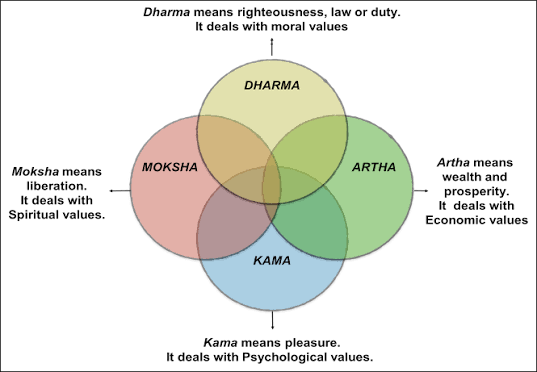
- Moksha: liberation — the end of the cycle, realized through knowledge (jnāna), devotion (bhakti), or right action (karma).
Dharma — living rightly
Dharma means duty, moral order, and appropriate conduct. It is contextual (age, role, time) but always points toward harmony, responsibility, and truth.
Maya — the veil of illusion
Maya describes how the world appears as many and separate while the truth is one. Spiritual practice removes this veil.
3. Primary Spiritual Paths in Hinduism
Hinduism recognizes multiple valid paths to the divine — choose one that fits your temperament:
- Bhakti (Devotion): Loving devotion to a personal deity (Krishna, Shiva, Devi). Practices: kirtan, puja, prayer, chanting.
- Jnana (Knowledge): Inquiry into the Self via study and self-inquiry (neti-neti, “not this, not this”). Practices: scriptural study, meditation, guru guidance.
- Karma (Action): Selfless action without attachment to results (nishkama karma). Practice: seva (service), ethical living.
- Raja (Royal Path): Systematic yoga (meditation, breath control, moral restraints) leading to samadhi (deep absorption).
These paths often overlap; great teachers combined them naturally.
4. Daily Spiritual Practices (Practical & Beginner-Friendly)
Spiritual practice should be simple, sustainable, and relevant to your life. Here are daily practices categorized by time-availability:
Micro-Practices (2–10 minutes)
- Morning breath awareness: Sit upright, 3 minutes of slow counting breath.
- Single-line gratitude: Write or think one line of thanks.
- Daily intention: “I will act kindly today.”
Short Practices (10–30 minutes)
- Guided meditation (10 min) — breath + body-scan. (Script below.)
- Mantra chanting (japa) — 108 or 11 repetitions of a short mantra (e.g., “Om Namah Shivaya”) with mala beads.
- Study (15 min) — read and reflect on one verse from the Bhagavad Gita or Upanishads.
Deeper Practices (30–60+ minutes)
- Seated meditation (30+ min) — steady attention on breath, thought-witnessing.
- Yoga & pranayama — sun salutations + alternate nostril breathing (anulom vilom).
- Puja — a short ritual of offering and focused devotion.
Simple guided breathing (5-minute script):
- Sit comfortably with spine straight.
- Close eyes and breathe naturally for 30 seconds.
- Inhale for 4 counts — hold for 2 — exhale for 6. Repeat for 3 minutes.
- Finish with a quiet intention: “May I be calm, may I act wisely.”
5. Practices Specific to Hindu Spiritualism
- Japa (mantra repetition): Repetition aligns mind and heart; choose a simple mantra.
- Arti and Puja: Symbolic rituals that cultivate reverence and focus.
- Pilgrimage (tīrtha yātrā): Visit holy places (e.g., Varanasi) for devotion and inner renewal.
- Vrata (fasting): Discipline and purification; can be a tool for clarity.
- Satsang & Kirtan: Community singing and discourse — powerful to open the heart.
6. Role of Guru & Community
A guru (teacher) helps remove ignorance by pointing the seeker toward truth. A teacher’s role is not to replace inner work, but to demonstrate and guide. Satsang — the company of spiritual people — supports practice and keeps you on the path.
7. How Hindu Spiritualism Addresses Modern Problems
- Stress & Burnout: Breathwork and meditation regulate the nervous system.
- Meaning & Purpose: Dharma-based living gives ethical direction and inner satisfaction.
- Loneliness: Satsang, community, and devotional practice restore connection.
- Ethical confusion: Karma and dharma offer a framework for right action.
Modern science supports many of these benefits: meditation reduces stress hormones, improves attention, and enhances emotional regulation.
8. Core Scriptures & Texts to Explore
- Vedas: foundational hymns and rituals.
- Upanishads: the philosophical heart — on Ātman and Brahman.
- Bhagavad Gita: practical teachings on action, devotion, and knowledge.
- Yoga Sutras of Patanjali: framework for meditative discipline.
- Puranas & Ramayana/Mahabharata: stories that transmit values and spiritual wisdom.
What Does Hinduism Teach About Karma and Reincarnation?
In Hinduism, karma means that every action — good or bad — creates an effect that will return to the doer, either in this life or future ones. It’s the spiritual law of cause and effect: you reap what you sow.
Reincarnation (or rebirth) is the process where the soul (Atman) takes a new body after death. The type of life one is born into depends on the karma accumulated from past actions.
The ultimate goal is to break this cycle of birth and rebirth (samsara) by living righteously (dharma), performing selfless actions, and realizing the true Self — leading to moksha, or liberation from all cycles.
9. Real-Life Examples & Saints (Practical Inspiration)
Throughout India’s history, countless saints and spiritual masters have embodied the essence of Hindu spiritualism — not by withdrawing from life, but by transforming it into a path of awakening.
Each of them represents a unique way to realize the Divine: through knowledge, devotion, meditation, or service.
Adi Shankaracharya (8th century CE) – The Philosopher of Oneness
Adi Shankaracharya revitalized Hinduism at a time when rituals overshadowed true spiritual understanding. He taught Advaita Vedanta — the philosophy of non-dualism, which declares that the individual soul (Atman) and the ultimate reality (Brahman) are one.
He traveled across India, debating scholars, writing profound commentaries on the Upanishads, Bhagavad Gita, and Brahma Sutras, and establishing four mathas (spiritual centers).
His message remains timeless:
You are not this body or mind; you are pure consciousness — eternal, free, and blissful.”
Shankaracharya’s life shows that spiritual liberation is possible through wisdom (Jnana Yoga) and disciplined self-inquiry.
Ramana Maharshi (1879–1950) – The Sage of Silence
Ramana Maharshi attained self-realization at the age of 16 through a profound inner experience of death and rebirth of the ego. His entire teaching revolves around a single question:
Who am I?” (Atma Vichara)
He taught that self-inquiry is the most direct path to liberation. By continuously turning attention inward — beyond thoughts, feelings, and identity — one discovers the silent awareness that is one’s true Self.
Thousands visited his ashram in Tiruvannamalai, not for elaborate lectures, but to simply sit in his silent presence, which radiated deep peace.
Ramana’s life teaches us that enlightenment is not about external renunciation, but about dissolving the false sense of “I.”
Sri Ramakrishna Paramahamsa (1836–1886) & Swami Vivekananda (1863–1902) – The Masters of Devotion and Universalism
Ramakrishna practiced every major spiritual path — devotion (bhakti), meditation (dhyana), knowledge (jnana), and even paths outside Hinduism — and realized the same divine truth in all.
He often said:
As many faiths, so many paths.”
His foremost disciple, Swami Vivekananda, carried these teachings to the world, famously addressing the Parliament of Religions in Chicago in 1893.
He emphasized practical spirituality — service to humanity as worship of God — and inspired millions to live fearlessly with purpose and compassion.
Together, Ramakrishna and Vivekananda showed that spirituality is not escapism — it’s strength, action, and love in motion.
Neem Karoli Baba (1900–1973) & Mata Amritanandamayi Devi (Amma, b. 1953) – The Path of Love and Service
Neem Karoli Baba, often called Maharaj-ji, embodied bhakti and compassion. His simple message — “Love everyone, serve everyone, remember God” — transcended all barriers of religion or nationality.
He inspired global figures like Ram Dass and countless seekers toward a life of devotion and simplicity.
10. Practical 30-Day Starter Plan (for beginners)
Week 1 — Foundation (5–10 min daily)
- Morning: 3-minute breathing + one-line gratitude.
- Evening: read one verse from the Gita or a short story.
Week 2 — Build Practice (10–15 min daily)
- Add a 10-minute guided meditation.
- Try japa for 5 minutes.
Week 3 — Deepen (20–30 min)
- Longer meditation or reading + short journal entry.
- Attend one satsang/online talk.
Week 4 — Integrate
- Practice selfless action for one day (seva).
- Reflect: what changed? Set a sustainable routine.
11. Frequently Asked Questions (FAQ)
Q1. Is spiritualism the same as religion in Hinduism?
A: No. Religion is outward practice and community; spiritualism is the inward pursuit of truth. Hinduism allows both: rituals and deep spiritual enquiry.
Q2. Can anyone follow Hindu spiritual practices without being Hindu?
A: Yes. Many practices (meditation, breathwork, ethical living) are universal and available to anyone seeking inner growth.
Q3. What is the fastest path to Moksha?
A: There is no single “fastest” path. Different temperaments respond to different paths: jnana (knowledge), bhakti (devotion), karma (selfless action) or raja (yoga). Sincerity and consistent practice matter most.
Q4. What is a Guru’s role today?
A: A guru clarifies doubts, models the path, and guides practice. In modern times, a teacher can be an authentic living guide, a trusted book, or a respected spiritual community.
Q5. How do I begin meditation as a beginner?
A: Start with 3–5 minutes daily, focus on breath, accept distractions kindly, and gradually increase time. Use guided audios if helpful.
Q6. Is chanting necessary in spiritual practice?
A: No, chanting (japa) is powerful but optional. It helps focus the mind and cultivate devotion, but simple breath awareness and ethical action are equally valid.
Q7. Can spiritual practice help with anxiety or depression?
A: Many practices — breathwork, mindfulness, and community support — can reduce anxiety and improve mood. For clinical conditions, combine practice with professional medical care.
Q8: What does Hinduism teach about karma and reincarnation?
A: Hinduism teaches that every action (karma) has consequences that shape our future lives through reincarnation. The soul is reborn until it attains liberation (moksha) by overcoming past karma through righteous living and self-realization.
Final Thoughts & Next Steps
Spiritualism in Hinduism is a rich, flexible tradition. It offers practical tools — meditation, service, ethical living, and devotion — to lead a life of meaning and inner freedom. Begin small: choose one practice today, follow it for 30 days, and note how your mind and choices change.
6 replies on “Spiritualism in Hinduism: Meaning, Beliefs, Practices & Core Concepts”
[…] Read About Spiritualism in Hinduism […]
[…] Read More About Spiritualism in Hinduism […]
[…] READ MORE ABOUT SPIRITUALISM IN HINDUISM […]
[…] Spiritualism in hindusim […]
[…] Spiritualism in hindusim […]
[…] in HinduismKarma Yoga in HindusimWhat Are Chakras in Hinduism? Understanding Your Energy BodySpiritualism in hindusimMorning Spiritual RoutineDharma In […]