
Karma Yoga (कर्म योग) is the yoga of action — a spiritual path taught clearly in the Bhagavad Gita that shows how to transform ordinary work into a means for inner freedom. This article explains what Karma Yoga really is, why it matters, how it appears in scripture, its benefits, ten practical principles to live by, three practical types you’ll meet in life, and how to practice it daily. Read on to find everything a sincere seeker needs to know.
Let’s start with a poem
Plant your seeds with hands that give,
Work with love, not thirst to live.
Let the fruit fall where it will —
Keep the heart peaceful, quiet, still.
This is the slow, soft way to be —
Action as prayer, your soul set free.
1. What is Karma Yoga? OR karma Yoga Definition?
Karma Yoga literally means the “yoga of action” — karma = action, yoga = union. In practice, Karma Yoga teaches that every action can be an opportunity for spiritual growth when done with the right attitude.
Karma Yoga in Hinduism is not rejection of work; it is a way to act without attachment to results, transforming duty into devotion.
Shortly: Karma Yoga = perform your duty, but renounce the obsession with the fruit.
Bhagavad Gita highlights this key attitude:
“You have a right to action only, never to its fruits.” — BG 2.47 (paraphrase)
This central teaching—nishkama karma (action without desire for result)—is the heart of Karma Yoga
Read More About Karma and Reincarnation in Hinduism
2. Karma Yoga in the Bhagavad Gita (Where It Appears & Core Teachings)
The Bhagavad Gita (भगवद् गीता) is the heart of Hindu philosophy and the most complete guide to Karma Yoga — the Yoga of Selfless Action. It is presented as a divine conversation between Lord Krishna and Arjuna on the battlefield of Kurukshetra.
When Arjuna is confused and refuses to fight, Krishna does not tell him to escape his duty. Instead, He teaches him how to act without attachment, without ego, and without being enslaved by success or failure — this, Krishna says, is Karma Yoga.
Where It Appears in the Gita
Karma Yoga is mainly discussed in Chapters 2, 3, 4, and 5 of the Gita, though its spirit runs throughout all 18 chapters.
- Chapter 2 (Sankhya Yoga) introduces the principle — act without clinging to results.
- Chapter 3 (Karma Yoga) expands it — action done with detachment purifies and leads to liberation.
- Chapter 4 (Jnana Karma Sanyasa Yoga) shows how action and knowledge unite.
- Chapter 5 (Karma Sanyasa Yoga) reconciles renunciation and action — true renunciation is inner, not outer.
Core Verses of Karma Yoga
Let’s look closely at the key verses that reveal the essence of Karma Yoga.
BG 2.47 — The Most Famous Verse on Karma Yoga
“Karmanye vadhikaraste ma phaleshu kadachana,
Ma karma-phala-hetur bhur ma te sangostvakarmani.”
Translation:
“You have the right to perform your prescribed duty,
but you are not entitled to the fruits of your actions.
Never consider yourself the cause of the results of your activities,
nor be attached to inaction.”
Meaning (in simple words):
Krishna tells Arjuna — your responsibility is to act according to Dharma (righteous duty). The results are not in your control — they depend on many factors, including time, other people’s actions, and divine will.
So, act sincerely, but don’t let the results control your mind.
BG 3.19 — Work Without Attachment
“Tasmad asaktah satatam karyam karma samachara,
Asakto hyacharan karma param apnoti purushah.”
Meaning:
“Therefore, always perform your duty without attachment, because by acting without attachment, a person attains the Supreme.”
Krishna reminds us that detachment is not indifference — it is inner freedom. You can still care deeply, but you no longer cling anxiously to the outcome. When action is pure, it becomes worship.
BG 3.30 — Surrender All Actions to the Divine
“Mayi sarvani karmani sannyasya adhyatma-chetasa,
Nirashi nirmamo bhutva yudhyasva vigata-jvarah.”
Meaning:
“Surrender all your actions to Me, with your mind fixed on the Self; free from desire, ego, and anxiety — perform your duty and fight.”
This verse adds the devotional heart to Karma Yoga — not only to act without attachment but to offer every act as a sacred offering to the Divine (Ishvara-Pranidhana).
When the sense of “I am the doer” fades, your work becomes effortless and joyful.
In Simple Terms:
Krishna’s message to Arjuna — and to all of us — can be summarized as:
“Act with full sincerity, without selfish desire, and surrender the result to the Divine. This is Karma Yoga.”
When we apply this in daily life — in our job, relationships, or service — every act becomes a meditation.
Success no longer inflates the ego, and failure no longer breaks the heart. You begin to work not for reward, but from inner peace.
A Poetic Reflection
Work you must, O seeker of light,
But let not fruit enslave your sight.
In every act, let ego cease —
For Karma done in love brings peace.
Read More About Spiritualism in Hinduism
3. Why Karma Yoga Matters — a short human reason
Most of us spend our lives working—jobs, family duties, caring for children, running errands. Karma Yoga shows how normal life becomes a spiritual laboratory. It answers: How to be spiritual without leaving the world? The answer is to work with the inner orientation of service, not selfish gain.
4. Three Practical Types of Karma Yoga (how people live it)
When searches ask “3 types of Karma Yoga,” readers expect practical categories. Here are three lived forms you’ll see:
A. Nishkama Karma Yoga (Selfless Service)
This is the classical Karma Yoga: action without desire for reward. Example: a nurse caring for patients purely out of compassion. The internal focus is service, not recognition.
B. Sakama-to-Nishkama Transition (Work with Intention, Grow into Selflessness)
Many begin doing work for reward (salary, praise). Karma Yoga recognizes this path and helps transform it: practicing presence and ethicality shifts the motive from reward to responsibility. Example: an entry-level employee who starts by seeking promotion but learns to serve clients sincerely and gradually works from a place of contribution.
C. Bhakti-Infused Karma Yoga (Action as Devotion)
Here action is offered as devotion — “I act for You.” The gardener, market vendor, or teacher who dedicates daily work to the Divine treats every task as worship. Practice includes short prayers or a mantra before the work. This blends Karma Yoga with Bhakti (devotion).
5. Karma Yoga Examples — everyday & epic
Everyday example:
You are a software engineer. Instead of coding only for bonuses, you code for quality — for users’ benefit — and let go of attachment to promotions. That shift—doing the duty with care and without clinging—embodies Karma Yoga.
Epic example (Mahabharata / Gita):
Arjuna’s battlefield duty is a classic Karma Yoga lesson. He is confused about killing his kinsmen, but Krishna explains that as a warrior his svadharma is to fight righteously. He must act without egoic desire for outcomes. This is the Gita’s central Karma Yoga teaching.
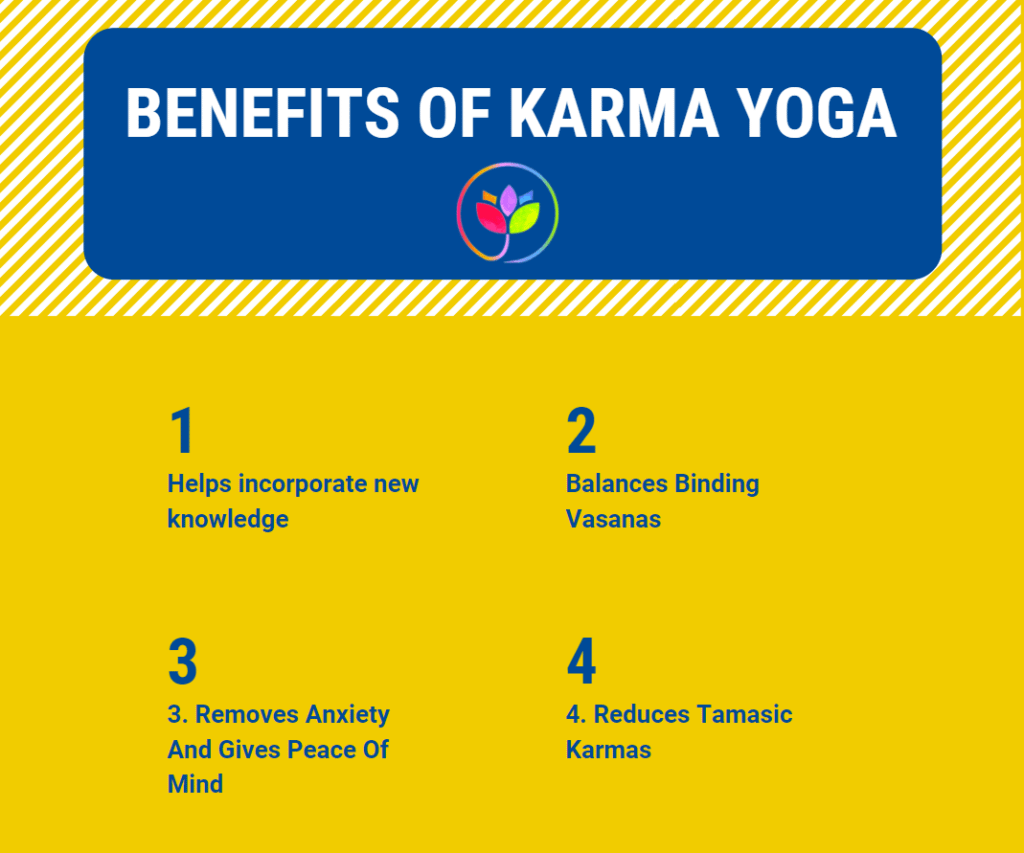
6. Benefits of Karma Yoga (practical & spiritual)
- Reduces anxiety — detachment from results reduces fear of failure.
- Purifies motivation — shifts from selfishness to service.
- Builds equanimity — you remain calm amid success and failure.
- Leads to inner freedom (gradually) — reduction of egoic cravings.
- Improves relationships and work quality — service orientation fosters trust.
- Path to moksha — the Gita promises liberation for those who act selflessly.
7. How to Practice Karma Yoga — step-by-step (30-day starter)
Week 1 — Awareness
- Each morning, spend 3 minutes: set intention — “I will do my work as service.” (Use mantra: “Om Tat Sat” or simply “May this be for good.”)
- Keep a small journal: note one action done with full attention.
Week 2 — Presence & Non-attachment
- Before each task, take one breath and remind yourself: I do my best, the rest I let go.
- Notice moments of craving for praise; gently redirect to the task.
Week 3 — Expand Service
- Do one small selfless act daily (help a coworker, a kind call). No expectation of return.
- At the end of the day, reflect on how that felt.
Week 4 — Surrender & Integration
- Offer results: mentally dedicate the day’s work to the Divine or higher purpose.
- Continue journaling: note shifts in stress, focus, and contentment.
8. The 10 Principles of Karma Yoga (Deeply Explained)
Use these ten guiding principles as a daily compass to transform ordinary work into spiritual practice. Each principle purifies the heart and connects action to inner freedom.
1. Nishkama (Selfless Action)
True Karma Yoga begins with Nishkama — performing your duty without selfish desire. It means doing what must be done, not for reward or recognition, but because it is right.
Example: A teacher who educates children out of love for learning, not for fame or praise.
When you detach from “what will I get,” you discover peace even amidst effort.
2. Perform Duty (Svadharma)
Svadharma means your own rightful duty — the work that aligns with your nature, role, or responsibility.
Krishna says in the Bhagavad Gita:
“Better is one’s own duty, though imperfectly performed, than another’s duty well performed.” (BG 3.35)
Perform your role sincerely — whether as a student, parent, leader, or artist — and you fulfill your part in the divine order.3. Right Intention (Sankalpa Shuddhi)
Before you begin any action, purify your intention. Ask: “Is this driven by ego or service?”
When your motives are clear — to uplift, not to harm — your actions naturally align with Dharma (righteousness).
As Swami Vivekananda said, “It is the heart, not the brain, that moves the world.” Pure intention empowers even small deeds with immense spiritual weight.4. Equanimity (Samatvam)
Equanimity means remaining balanced in success and failure, praise and blame.
Krishna defines yoga itself as:“Samatvam Yoga Uchyate” — Yoga is equanimity. (BG 2.48)
When you do your best and stay calm regardless of results, your mind becomes serene.
Example: Whether your idea is appreciated or rejected, you stay peaceful — because you know the effort was sincere.
This is the secret to lasting happiness in Karma Yoga.5. Detachment from Results (Phala-Tyaga)
Once you’ve acted sincerely, let go of the outcome. This is not laziness or indifference — it is trusting that results are shaped by many forces beyond your control.
Do your best effort, and then surrender the fruit.
It’s like planting a tree — you water it daily, but you don’t pull the roots to make it grow faster. Let nature (karma) take its course.6. Service (Seva Bhava)
Work done in the spirit of service (Seva) becomes worship. Every small act — cooking for your family, helping a colleague, cleaning your space — can be seen as service to humanity or to God.
This attitude melts the ego, replacing “I am doing this” with “I am serving through this.”
Service purifies the heart faster than knowledge alone.7. Presence (Ekaagrata)
Be fully present in what you do. Multi-tasking divides the mind; Karma Yoga unites it.
When you write, just write. When you speak, listen fully.
Presence transforms routine into meditation — and your everyday tasks become opportunities for mindfulness.
In presence, even washing dishes or typing code becomes sacred.8. Responsibility (Kartavya Bhava)
Karma Yoga teaches ownership without ego. Be responsible for your actions and their effects — don’t blame others or fate.
When you take responsibility, you grow in maturity and integrity.
Remember: your work is your offering — handle it with care, sincerity, and accountability.9. Self-Reflection (Atma-Nirikshana)
Karma Yoga is not mechanical work — it’s conscious action. Periodically reflect: Why am I doing this? Is there ego, greed, or expectation behind it?
Self-reflection refines your motive, removes impurities, and aligns you again with selfless service.
You can journal each evening: one action you did selflessly, one that carried attachment — and learn from both.10. Surrender (Ishvara-Pranidhana)
After all effort, offer everything to the Divine — whether you call it God, the Universe, or your Higher Self.
Say silently: “Whatever I do, I offer it to You.”
This surrender dissolves the sense of doership (ahamkara) and fills your heart with humility and peace.
When action becomes an offering, life becomes prayer.
Advanced view: Karma Yoga and other yogas
Karma Yoga often works with Bhakti Yoga (devotion) and Jnana Yoga (knowledge). A mature practitioner may act selflessly (Karma), with love (Bhakti), while seeing the ultimate truth (Jnana). The Gita encourages this integrated approach.
Conclusion
Karma Yoga turns life into practice. It asks only one honest thing: do your work with a free heart. When action becomes service, the chains of selfishness loosen and the soul grows free. Start small — one mindful action, one surrendered result — and you will begin to feel the quiet change.
Frequently Asked Questions about Karma Yoga
1. How is Karma Yoga practiced?
Karma Yoga is practiced by performing your daily actions with full sincerity, without attachment to the results. It means working not for personal gain but as an offering to the Divine or for the benefit of others.
You can practice Karma Yoga anywhere — at work, home, or in service — by maintaining selflessness (Nishkama Karma) and equanimity (Samatvam). For example, doing your job honestly without ego, helping others without expecting praise, or volunteering in your community are real-life expressions of Karma Yoga.
2. What is the main theme of Karma Yoga?
The main theme of Karma Yoga is selfless action — doing one’s duty without attachment to outcomes. It teaches that true spiritual growth comes not by running away from the world but by working in it with a pure heart and clear intention.
In the Bhagavad Gita, Lord Krishna tells Arjuna that one must act with detachment and dedication, seeing work as worship. When action is done without selfish desire, it purifies the mind and leads to liberation (moksha).
3. What are the characteristics of Karma Yoga?
The main characteristics of Karma Yoga include:
- Selflessness (Nishkama Karma): Acting without expecting results.
- Duty (Svadharma): Performing one’s responsibilities sincerely.
- Detachment (Vairagya): Remaining balanced in success and failure.
- Service (Seva): Seeing work as service to humanity or God.
- Surrender (Ishvara Pranidhana): Offering the results to the Divine.
A true Karma Yogi works with a calm mind, pure intention, and a sense of devotion. Their outer actions and inner peace are perfectly balanced.
4. What are the 4 pillars of Karma Yoga?
The four pillars of Karma Yoga are the foundational principles that guide the practice:
- Dharma (Righteous Duty): Performing actions aligned with moral and ethical responsibility.
- Detachment (Vairagya): Letting go of the desire for results.
- Selfless Service (Seva): Acting for the welfare of others without ego.
- Surrender (Ishvara Pranidhana): Dedicating all actions and their outcomes to the Divine.
These four pillars transform ordinary work into a spiritual discipline. Through these, a person purifies the heart and moves closer to liberation.
5. How does Karma Yoga lead to spiritual growth?
Karma Yoga helps dissolve ego and attachment — the two main causes of suffering. By serving selflessly and focusing on pure intention, one’s mind becomes calm and clear. Over time, this inner purity leads to spiritual awakening and liberation (moksha).
As Krishna says in the Bhagavad Gita, “By performing action without attachment, one attains the Supreme.” (BG 3.19)
6. Can anyone practice Karma Yoga?
Yes — anyone can practice Karma Yoga, regardless of religion, profession, or background. It is not limited to monks or saints. Whether you’re a student, teacher, parent, or businessperson — any work done with honesty, mindfulness, and compassion can become Karma Yoga.
It’s about transforming your attitude — not necessarily your activity.
7. What is the ultimate goal of Karma Yoga?
The ultimate goal of Karma Yoga is inner liberation (moksha) — freedom from attachment, ego, and the binding effects of karma. By acting without selfish desire, one attains peace, purity, and union with the Divine.
It transforms the doer from being a mere worker into a spiritual seeker — one who sees every act as a form of meditation and worship.
8 replies on “Karma Yoga Explained — Meaning, Principles, Benefits & Practical Guide”
[…] Read More About Karma Yoga Explained […]
[…] Karma Yoga: The Path of Selfless Action […]
[…] Read More About Karma Yoga in Hindusim […]
[…] Read More About Karma Yoga in Hindusim […]
[…] Karma Yoga in Hindusim […]
[…] Karma Yoga in Hindusim […]
One of the best blog explained by Prajapati motivation
[…] Mantra Meaning: Complete Spiritual GuideUnderstanding Karma and Reincarnation in HinduismKarma Yoga in HindusimWhat Are Chakras in Hinduism? Understanding Your Energy BodySpiritualism in hindusimMorning […]