Have you ever felt inexplicably tired despite sleeping well, or anxious without any apparent reason? What if these experiences aren’t random but signals from your body’s energy centers—the chakras in Hinduism—trying to communicate with you?
The concept of chakras in Hinduism represents one of the most profound discoveries of ancient Indian wisdom: that we’re not just physical bodies but intricate systems of spinning energy centers that influence every aspect of our existence—from physical health to spiritual enlightenment.
With thousands searching for “chakras in Hinduism” every month, modern seekers are rediscovering what Vedic sages knew 3,500 years ago: balancing your chakras isn’t mystical mumbo-jumbo—it’s practical energy management that transforms how you feel, think, and live.
In this complete guide, you’ll discover everything about chakras in Hinduism—what they are, where the 7 main chakras are located, their colors and meanings, how to identify blocked chakras, proven techniques to balance them, and real-life stories of people who transformed their lives through chakra awareness.
What Are Chakras in Hinduism? Understanding Your Energy Body
When people search for “chakras in Hinduism,” they’re seeking to understand a concept that bridges the physical and spiritual dimensions of human existence. So what exactly are chakras in Hinduism?
The word “chakra” (चक्र) comes from Sanskrit, meaning “wheel” or “disc.” Chakras in Hinduism are spinning vortexes of energy—invisible to the physical eye but powerfully real in their effects—that exist in your subtle body (sukshma sharira), distinct from but interconnected with your physical body.
Think of chakras in Hinduism as energy transformers. Just as electrical transformers convert high voltage to usable power for your home, chakras in Hinduism transform universal life force energy (prana) into forms your body, mind, and spirit can utilize for health, vitality, emotional balance, and spiritual evolution.
The Ancient Origins of Chakras in Hinduism
The concept of chakras in Hinduism first appeared in the Vedas, ancient Sanskrit texts dating back to 1500-500 BCE. The Rigveda, the oldest Veda, makes cryptic references to energy centers, though the elaborate system we know today evolved later.
The Upanishads, philosophical texts composed around 800-200 BCE, provide more explicit descriptions. The Yoga Upanishads particularly emphasize the role of chakras in Hinduism for spiritual awakening and liberation (moksha).
However, the most detailed exposition of chakras in Hinduism comes from Tantric texts composed between the 8th and 11th centuries CE. The Sat-Chakra-Nirupana (Investigation of the Six Chakras), written by Swami Purnanda in 1577, systematized the seven-chakra model that became standard in Hindu tradition.
These ancient texts weren’t written as theoretical philosophy but as practical manuals for yogis and spiritual seekers. The sages who discovered chakras in Hinduism did so through direct inner experience during deep meditation states, then codified their findings for future generations.
How Many Chakras Are There in Hinduism?
Here’s where it gets interesting: when we talk about chakras in Hinduism, most people think of seven. But traditional Hindu texts actually describe 114 chakras throughout the human energy system!
Among these 114 chakras in Hinduism:
- 7 are major chakras (the ones everyone knows)
- 21 are minor chakras
- 86 are micro chakras
The seven major chakras in Hinduism that we’ll focus on are the ones with the most profound impact on your daily life, running vertically along your spine from its base to the crown of your head.
Why focus on just seven? Because mastering these seven major chakras in Hinduism creates a domino effect that positively influences all 114 energy centers. It’s like adjusting the main valves in a complex plumbing system—fix the primary flow, and the entire system functions better.
Read More About Karma Yoga in Hindusim
The Science Behind Chakras in Hinduism
While chakras in Hinduism originate from spiritual tradition, modern science offers intriguing parallels. The locations of the seven major chakras in Hinduism correspond remarkably with major nerve plexuses and endocrine glands in the body:
- Root Chakra → Sacral nerve plexus & adrenal glands
- Sacral Chakra → Pelvic plexus & reproductive glands
- Solar Plexus Chakra → Solar plexus & pancreas
- Heart Chakra → Cardiac plexus & thymus gland
- Throat Chakra → Pharyngeal plexus & thyroid gland
- Third Eye Chakra → Carotid plexus & pituitary gland
- Crown Chakra → Pineal gland
This isn’t coincidental. The ancient discoverers of chakras in Hinduism were mapping the same bio-energetic reality that modern physiology studies, just using different terminology and methodology.
Recent research in biofield science and quantum biology suggests that living organisms do generate measurable electromagnetic fields. While we can’t yet “prove” chakras in Hinduism exist with current scientific instruments, we also couldn’t “see” radio waves before we invented appropriate detection technology.
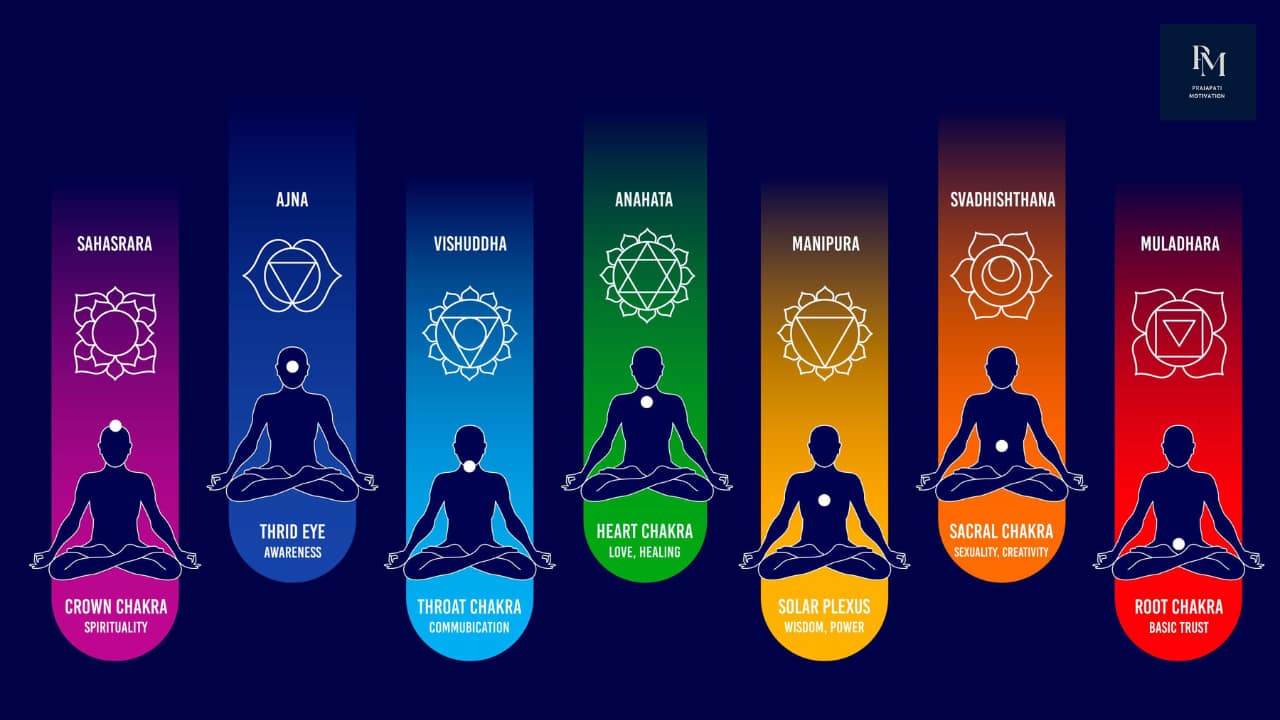
The 7 Main Chakras in Hinduism: Complete Guide
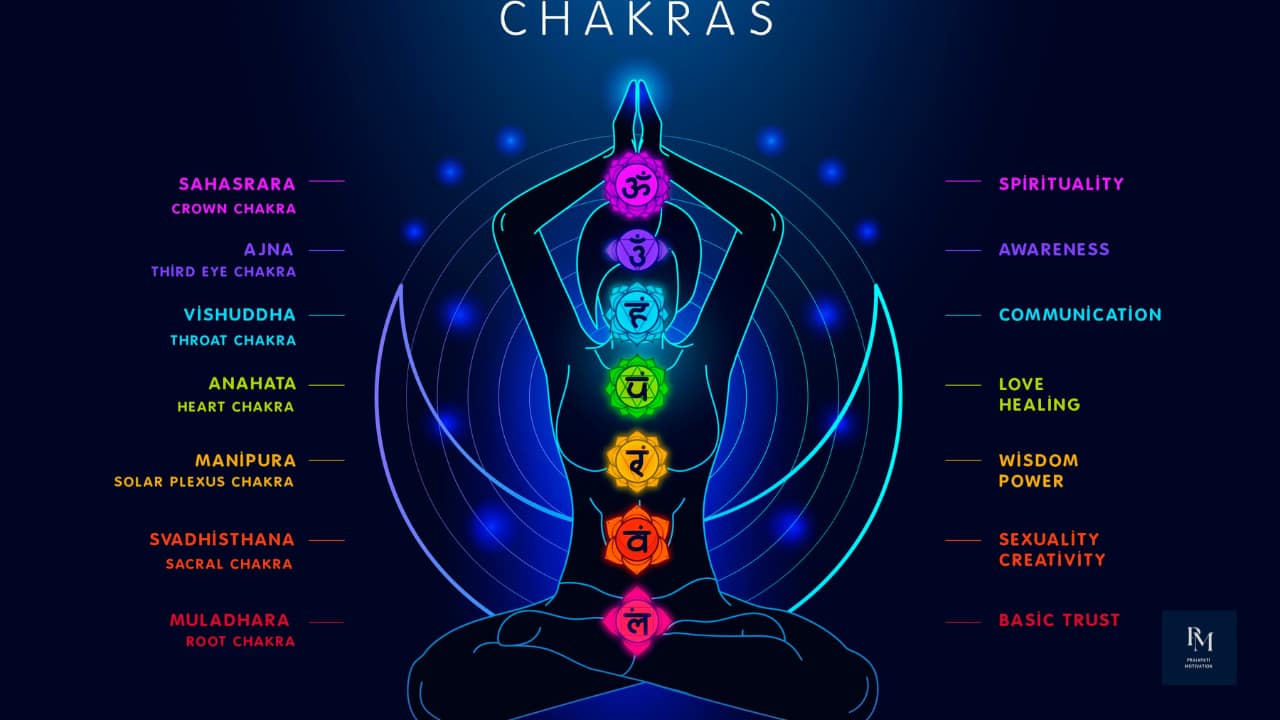
Let’s explore each of the seven major chakras in Hinduism in detail—their locations, colors, meanings, associated elements, Hindu deities, and how they influence your life.
1. Muladhara: The Root Chakra (मूलाधार)
Location: Base of the spine, between the anus and genitals
Color: Red
Element: Earth (Prithvi)
Bija Mantra: LAM (लं)
Hindu Deity: Lord Ganesha and Brahma
Petals: 4
Physical Associations: Legs, feet, bones, large intestine, adrenal glands
Meaning of Muladhara in Chakras of Hinduism: “Mula” means root and “adhara” means support or base. This first of the chakras in Hinduism is your foundation—your connection to the physical world, survival instincts, and sense of security.
The Root Chakra in Hinduism governs your most primal needs: food, shelter, safety, financial security. When balanced, you feel grounded, stable, and confident about meeting life’s basic challenges. When blocked, you experience chronic anxiety, financial stress, or feel “unrooted” and disconnected from reality.
Signs of Balanced Root Chakra:
- Feel safe and secure in the world
- Have financial stability or confidence in earning
- Good physical health and vitality
- Strong connection to family and community
- Ability to set healthy boundaries
Signs of Blocked Root Chakra:
- Chronic anxiety and fear, especially about survival
- Financial problems or extreme scarcity mindset
- Feeling ungrounded, spacey, or disconnected
- Lower back pain, leg problems, or digestive issues
- Difficulty completing tasks or following through
Real-Life Example: Ramesh, a 42-year-old businessman, grew up in poverty. Even after becoming financially successful, he hoarded money compulsively and lived in constant fear of losing everything. A yoga teacher identified this as a blocked Root Chakra. Through grounding practices—walking barefoot on earth, eating root vegetables, chanting LAM—Ramesh gradually developed a felt sense of safety. Six months later, he’d released his death grip on money and started enjoying life, knowing he could handle whatever came.
2. Svadhisthana: The Sacral Chakra (स्वाधिष्ठान)
Location: Lower abdomen, about 2 inches below the navel
Color: Orange
Element: Water (Jala)
Bija Mantra: VAM (वं)
Hindu Deity: Lord Vishnu
Petals: 6
Physical Associations: Reproductive organs, kidneys, bladder, circulatory system
Meaning of Svadhisthana in Chakras of Hinduism: “Sva” means self and “adhisthana” means dwelling place—literally “one’s own dwelling.” This second of the chakras in Hinduism governs pleasure, creativity, sexuality, and emotional intelligence.
The Sacral Chakra in Hinduism is your creative center—not just artistic creativity but your ability to create anything new: relationships, projects, solutions, experiences. It’s also where you experience pleasure and process emotions, particularly those related to relationships and intimacy.
Signs of Balanced Sacral Chakra:
- Healthy sexual expression and enjoyment
- Creative flow and inspiration
- Emotional intelligence and flexibility
- Ability to experience pleasure without guilt
- Healthy, balanced relationships
Signs of Blocked Sacral Chakra:
- Sexual dysfunction or unhealthy attitudes toward sex
- Creative blocks and lack of inspiration
- Emotional numbness or overwhelming emotions
- Guilt around pleasure and enjoyment
- Reproductive issues or urinary problems
Real-Life Example: Kavita, a 29-year-old graphic designer, hit a creative wall. For six months, she couldn’t design anything she liked—everything felt forced and lifeless. Her mentor suggested her Sacral Chakra might be blocked. Kavita started swimming (water element), wearing orange, and working with creative visualization. Within weeks, her creative flow returned, but with a surprising side effect: she also became more comfortable expressing emotions she’d suppressed for years. Understanding chakras in Hinduism helped her see that creativity and emotional health are interconnected.
3. Manipura: The Solar Plexus Chakra (मणिपुर)
Location: Upper abdomen, just below the ribcage
Color: Yellow
Element: Fire (Agni)
Bija Mantra: RAM (रं)
Hindu Deity: Maharudra Shiva
Petals: 10
Physical Associations: Digestive system, liver, gallbladder, pancreas, metabolism
Meaning of Manipura in Chakras of Hinduism: “Mani” means gem and “pura” means city—”city of jewels.” This third of the chakras in Hinduism is your power center, governing self-esteem, willpower, personal identity, and transformation.
The Solar Plexus Chakra in Hinduism is your inner sun—the source of your personal power, confidence, and ability to take action. Just as fire transforms raw food into digestible nutrients, this chakra transforms your raw potential into manifest reality through willpower and decisive action.
Signs of Balanced Solar Plexus Chakra:
- Strong sense of self and healthy self-esteem
- Natural confidence without arrogance
- Ability to set and achieve goals
- Good digestion and metabolism
- Healthy relationship with power and authority
Signs of Blocked Solar Plexus Chakra:
- Low self-esteem and lack of confidence
- People-pleasing and inability to say no
- Digestive problems (IBS, ulcers, etc.)
- Control issues or victim mentality
- Procrastination and lack of willpower
Real-Life Example: Anjali, a 35-year-old manager, was brilliant but constantly undermined herself. In meetings, she’d apologize before sharing ideas. She couldn’t make decisions without seeking validation. Through pranayama (breath of fire), core-strengthening yoga, and wearing yellow, she worked on her Solar Plexus Chakra. The transformation was dramatic: within three months, colleagues noticed her newfound assertiveness. She got promoted six months later. The chakras in Hinduism framework gave her a practical map for reclaiming her personal power.
4. Anahata: The Heart Chakra (अनाहत)
Location: Center of the chest
Color: Green (secondary: Pink)
Element: Air (Vayu)
Bija Mantra: YAM (यं)
Hindu Deity: Ishvara (Shiva)
Petals: 12
Physical Associations: Heart, lungs, circulatory system, immune system, thymus gland
Meaning of Anahata in Chakras of Hinduism: “Anahata” means “unstruck” or “unbeaten”—referring to the unstruck sound of the cosmic vibration (Anahata Nada) that yogis hear in deep meditation. This fourth of the chakras in Hinduism is the bridge between the lower physical chakras and upper spiritual chakras.
The Heart Chakra in Hinduism governs love (not just romantic but universal compassion), forgiveness, empathy, and connection. It’s where we transcend the ego’s needs (first three chakras) and begin experiencing unity consciousness. When this chakra opens, you feel love not as an emotion dependent on external circumstances but as your natural state of being.
Signs of Balanced Heart Chakra:
- Capacity for unconditional love and compassion
- Healthy boundaries while remaining open
- Ability to forgive self and others
- Deep connection and empathy with others
- Healthy immune system
Signs of Blocked Heart Chakra:
- Difficulty giving or receiving love
- Holding grudges and inability to forgive
- Loneliness and isolation
- Codependency or emotional walls
- Respiratory or cardiovascular issues
Real-Life Example: After a devastating divorce, Suresh, 48, built walls around his heart. For three years, he functioned—worked, parented, existed—but felt emotionally dead. His therapist introduced him to the concept of chakras in Hinduism, particularly focusing on his Heart Chakra. Through loving-kindness meditation, volunteering, and heart-opening yoga poses, Suresh slowly thawed. The breakthrough came when he could finally cry—releasing years of suppressed grief. A year later, he was in a healthy new relationship, but more importantly, he’d reconnected with his own capacity to feel and love deeply.
Read More About What is Moksha in Hinduism? Understanding Ultimate Liberation
5. Vishuddha: The Throat Chakra (विशुद्ध)
Location: Throat, at the level of the larynx
Color: Blue
Element: Space/Ether (Akasha)
Bija Mantra: HAM (हं)
Hindu Deity: Sadashiva
Petals: 16
Physical Associations: Throat, thyroid, parathyroid, jaw, neck, mouth
Meaning of Vishuddha in Chakras of Hinduism: “Vishuddha” means “especially pure” or “purification.” This fifth of the chakras in Hinduism governs communication, self-expression, truth, and authenticity.
The Throat Chakra in Hinduism is about expressing your truth—not just speaking but living authentically. It’s the energetic center where inner experience becomes outer expression. When balanced, your words align with your truth, and you communicate clearly, honestly, and effectively.
Signs of Balanced Throat Chakra:
- Speak your truth with clarity and kindness
- Excellent listening skills
- Creative self-expression (writing, speaking, singing)
- Living authentically, not wearing masks
- Clear, resonant voice
Signs of Blocked Throat Chakra:
- Difficulty expressing thoughts and feelings
- Fear of speaking up or speaking out
- Lying or gossiping habitually
- Neck pain, thyroid issues, or sore throats
- Feeling misunderstood or not heard
Real-Life Example: Priya, a 26-year-old software engineer, had brilliant ideas but stayed silent in meetings. She’d compose perfect emails, then delete them. Her inability to speak up was holding back her career. After learning about chakras in Hinduism, she focused on her Throat Chakra—singing in the shower, journaling her truth, wearing blue. The real breakthrough came when she started saying “no” to things she didn’t want—something she’d never done. Six months later, she confidently presented a major project to senior leadership. Understanding her Throat Chakra gave her permission to use her voice.
6. Ajna: The Third Eye Chakra (आज्ञा)
Location: Forehead, between the eyebrows
Color: Indigo/Deep Blue/Purple
Element: Light (beyond five physical elements)
Bija Mantra: OM (ॐ)
Hindu Deity: Ardhanarishvara (Shiva-Shakti united)
Petals: 2
Physical Associations: Eyes, brain, pituitary gland, pineal gland
Meaning of Ajna in Chakras of Hinduism: “Ajna” means “command” or “to perceive”—the command center of perception. This sixth of the chakras in Hinduism governs intuition, insight, imagination, wisdom, and the ability to see beyond physical reality.
The Third Eye Chakra in Hinduism is where you access non-ordinary perception—intuition, foresight, inner vision, and connection to higher guidance. It’s not about seeing ghosts or having supernatural powers (though those may come); it’s about seeing reality clearly, without the distortions of ego and conditioning. This is the chakra that discerns truth from illusion.
Signs of Balanced Third Eye Chakra:
- Strong intuition and inner guidance
- Ability to visualize and manifest
- Clear thinking and good judgment
- Remembering dreams and receiving insights
- Seeing patterns and connections others miss
Signs of Blocked Third Eye Chakra:
- Lack of clarity and mental fog
- Difficulty making decisions
- Disconnection from intuition
- Overly rational or overly fantastical
- Headaches, vision problems, nightmares
Real-Life Example: Rohit, a 39-year-old entrepreneur, made decisions purely from spreadsheets and logic. While financially successful, he felt something was missing. After a business partner betrayed him—something everyone’s “gut” had warned about except Rohit—he explored chakras in Hinduism. Focusing on his Third Eye through meditation and visualization, Rohit gradually reconnected with his intuition. The transformation was subtle but profound: he started “knowing” things before logical analysis confirmed them. His business improved not from working harder but from making wiser, more intuitive decisions.
7. Sahasrara: The Crown Chakra (सहस्रार)
Location: Crown of the head
Color: Violet/White/Gold
Element: Cosmic consciousness (beyond elements)
Bija Mantra: Silence / OM
Hindu Deity: Lord Shiva
Petals: 1,000 (symbolizing infinite)
Physical Associations: Brain, nervous system, pineal gland
Meaning of Sahasrara in Chakras of Hinduism: “Sahasrara” means “thousand-petaled”—symbolizing infinite consciousness. This seventh of the chakras in Hinduism represents your connection to the divine, universal consciousness, and spiritual enlightenment.
The Crown Chakra in Hinduism is the gateway to moksha (liberation). It’s where individual consciousness realizes its unity with universal consciousness—the ultimate goal of all yoga and spiritual practice in Hinduism. This isn’t about believing in God; it’s about direct experience of the divine nature of existence.
Signs of Balanced Crown Chakra:
- Sense of unity with all existence
- Inner peace independent of circumstances
- Access to higher wisdom and guidance
- Living with purpose and meaning
- Transcendence of ego identification
Signs of Blocked Crown Chakra:
- Feeling disconnected from spirituality
- Existential depression or meaninglessness
- Rigid beliefs and closed-mindedness
- Excessive materialism
- Spiritual bypassing or delusion
Real-Life Example: Meera, 52, had everything—successful career, loving family, financial security—yet felt a gnawing emptiness. “Is this all there is?” she’d ask. Through daily meditation focusing on her Crown Chakra, she experienced what she describes as “the veil lifting”—a profound shift in perception where separation dissolved. She didn’t become a monk or abandon her life; she continued working and family responsibilities, but from a completely different understanding. The framework of chakras in Hinduism gave her a map for this spiritual awakening. Now, ordinary moments—making tea, watching sunset—carry the depth of divine connection.
How Chakras in Hinduism Relate to Kundalini and Spiritual Awakening
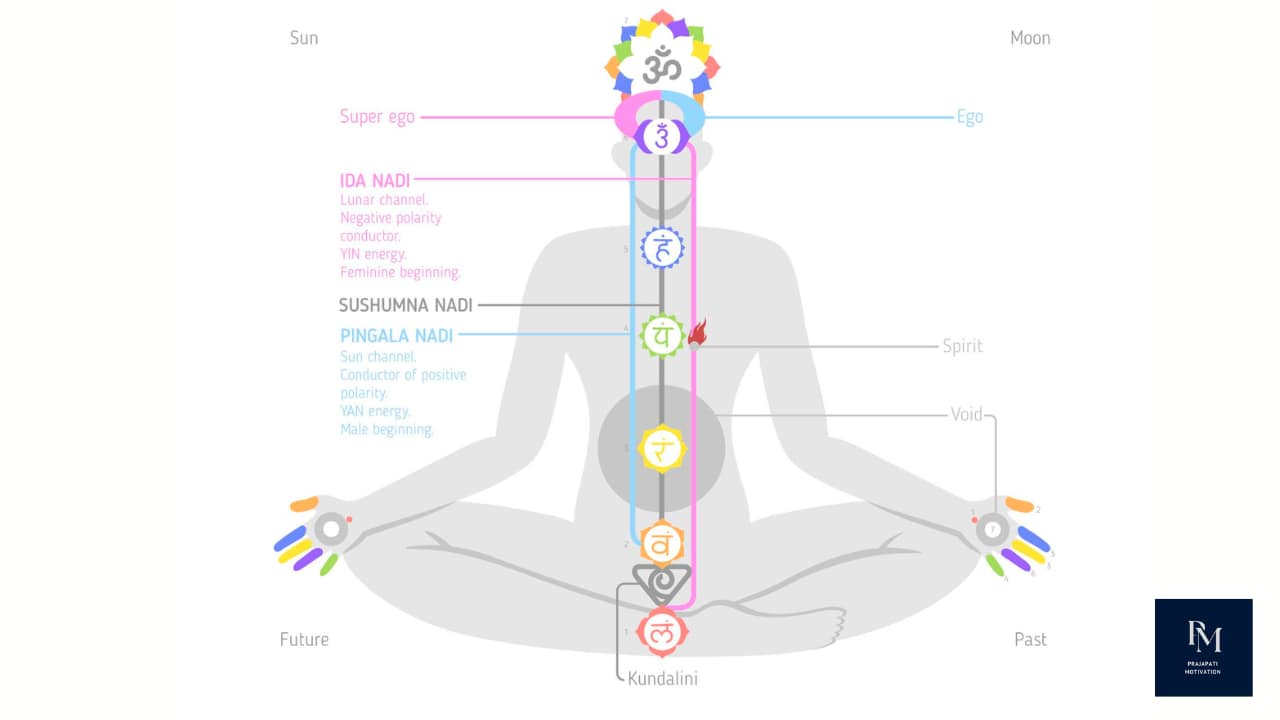
Understanding chakras in Hinduism is incomplete without discussing Kundalini Shakti—the dormant spiritual energy coiled at the base of the spine like a sleeping serpent.
In the framework of chakras in Hinduism, Kundalini represents your evolutionary potential—the power to transform from ordinary human consciousness to divine consciousness. She (Kundalini is considered feminine energy) sleeps in the Root Chakra until awakened through spiritual practice.
The Journey of Kundalini Through Chakras in Hinduism
When Kundalini awakens—through yoga, meditation, mantra, or sometimes spontaneously—she rises up the central energy channel (Sushumna nadi) that runs along the spine, piercing and activating each of the chakras in Hinduism sequentially:
Muladhara → Svadhisthana → Manipura → Anahata → Vishuddha → Ajna → Sahasrara
As Kundalini passes through each chakra, she awakens its full potential—transforming your consciousness at that level. When she finally reaches the Crown Chakra and unites with Shiva (pure consciousness), the yogi experiences Samadhi—the state of enlightenment and liberation (moksha) that is the ultimate goal of the chakra system in Hinduism.
The Three Granthis (Knots) in Chakras of Hinduism
Along this journey, Kundalini must pierce three major “knots” (granthis) in the chakras of Hinduism:
- Brahma Granthi (Knot of Brahma): Located at the Root Chakra, this represents attachment to physical security and survival
- Vishnu Granthi (Knot of Vishnu): Located at the Heart Chakra, this represents attachment to relationships and emotions
- Rudra Granthi (Knot of Rudra): Located at the Third Eye Chakra, this represents attachment to spiritual experiences and psychic powers
These knots are the major obstacles in spiritual evolution through the chakras in Hinduism. They must be dissolved through practice, surrender, and grace.
Important Safety Note: Kundalini awakening is not a casual practice. While gentle chakra balancing is safe for everyone, deliberately trying to force Kundalini awakening without proper preparation and guidance can cause physical, emotional, and psychological disturbances. The traditional approach to chakras in Hinduism emphasizes gradual, balanced development under the guidance of an experienced teacher.
How to Balance Your Chakras in Hinduism: Practical Techniques
Now that you understand the chakras in Hinduism theoretically, how do you actually work with them? Here are proven techniques for balancing each chakra.
Universal Practices for All Chakras in Hinduism
Before focusing on specific chakras, these practices support overall chakra health:
1. Pranayama (Breath Control): Prana (life force) is the energy that flows through chakras in Hinduism. Conscious breathing purifies energy channels and balances chakras.
- Practice: Nadi Shodhana (alternate nostril breathing) for 10 minutes daily
2. Meditation: Sitting in stillness allows awareness to flow through chakras, naturally bringing them into balance.
- Practice: 15-20 minutes daily meditation, observing without judgment
3. Yoga Asanas: Specific physical postures directly affect chakras in Hinduism by creating pressure, stretch, or stimulation at chakra locations.
- Practice: Daily yoga focusing on spinal health
4. Mantra Chanting: Sound vibrations directly influence chakras in Hinduism, with each bija mantra resonating with its specific chakra.
- Practice: Chant each chakra’s bija mantra 108 times
5. Visualization: The mind powerfully influences energy. Visualizing chakras in Hinduism as vibrant, spinning wheels of colored light activates and balances them.
- Practice: Chakra visualization meditation (described below)
Chakra-Specific Balancing Techniques
For Root Chakra (Muladhara):
- Physical: Walk barefoot on earth, gardening, grounding yoga poses (Mountain Pose, Warrior poses)
- Food: Root vegetables (potatoes, carrots, beets), protein-rich foods
- Crystals: Red jasper, hematite, black tourmaline
- Affirmations: “I am safe,” “I am grounded,” “I have everything I need”
For Sacral Chakra (Svadhisthana):
- Physical: Swimming, hip-opening yoga poses (Pigeon, Goddess), dancing
- Food: Orange foods (oranges, carrots, mangoes), water, herbal teas
- Crystals: Carnelian, orange calcite, moonstone
- Affirmations: “I embrace pleasure,” “I am creative,” “My emotions flow freely”
For Solar Plexus Chakra (Manipura):
- Physical: Core exercises, sun exposure, Breath of Fire pranayama
- Food: Yellow foods (bananas, corn, yellow peppers), whole grains
- Crystals: Citrine, tiger’s eye, yellow jasper
- Affirmations: “I am confident,” “I am powerful,” “I take action with ease”
For Heart Chakra (Anahata):
- Physical: Heart-opening poses (Camel, Cobra, Bow), loving-kindness meditation
- Food: Green vegetables (spinach, kale, broccoli), green tea
- Crystals: Rose quartz, green aventurine, jade
- Affirmations: “I love and am loved,” “I forgive,” “My heart is open”
For Throat Chakra (Vishuddha):
- Physical: Singing, chanting, neck stretches, speaking your truth
- Food: Blueberries, herbal teas, honey, water
- Crystals: Blue lace agate, lapis lazuli, aquamarine
- Affirmations: “I speak my truth,” “I express myself clearly,” “I am heard”
For Third Eye Chakra (Ajna):
- Physical: Meditation, visualization, eye exercises, reducing screen time
- Food: Purple foods (grapes, eggplant, purple cabbage), omega-3s
- Crystals: Amethyst, lapis lazuli, purple fluorite
- Affirmations: “I trust my intuition,” “I see clearly,” “I am wise”
For Crown Chakra (Sahasrara):
- Physical: Silent meditation, prayer, time in nature, fasting
- Food: Light, pure foods; fasting or detoxing
- Crystals: Clear quartz, amethyst, selenite
- Affirmations: “I am divine,” “I am connected to all,” “I trust the universe”
How to Identify Which Chakras Are Blocked: Self-Assessment
Understanding chakras in Hinduism is useless if you can’t identify which ones need attention. Here’s a comprehensive self-assessment to discover your chakra imbalances.
The Chakra Health Questionnaire
For each statement, rate yourself on a scale of 1-5: 1 = Never/Not at all 5 = Always/Completely
Root Chakra Assessment:
- I feel safe and secure in my daily life
- I have financial stability or confidence in my ability to meet needs
- I feel grounded and connected to my body
- I can trust others and life in general
- I have a stable home and feel rooted
Sacral Chakra Assessment:
- I enjoy healthy sexual expression
- I feel creative and inspired regularly
- I can express my emotions appropriately
- I experience pleasure without guilt
- My relationships are balanced and fulfilling
Solar Plexus Chakra Assessment:
- I have strong self-esteem and confidence
- I can make decisions without excessive second-guessing
- I feel comfortable asserting myself
- My digestion is healthy
- I take responsibility without being a victim or controlling
Heart Chakra Assessment:
- I give and receive love easily
- I can forgive myself and others
- I feel compassion for people
- I maintain healthy boundaries
- I rarely hold grudges
Throat Chakra Assessment:
- I express my thoughts and feelings clearly
- I speak my truth even when difficult
- People understand what I’m trying to communicate
- I’m a good listener
- I live authentically without pretending
Third Eye Chakra Assessment:
- My intuition is strong and reliable
- I remember my dreams
- I think clearly and make good decisions
- I can visualize easily
- I’m open to new perspectives
Crown Chakra Assessment:
- I feel connected to something greater than myself
- My life has meaning and purpose
- I experience inner peace regularly
- I’m open to spiritual experiences
- I don’t feel existentially alone
Scoring: Add up your scores for each chakra (5 questions × 5 points = maximum 25 points per chakra)
- 20-25 points: Chakra is balanced and healthy
- 15-19 points: Chakra is mostly balanced with minor blocks
- 10-14 points: Chakra has moderate blockages needing attention
- 5-9 points: Chakra is significantly blocked and requires focused work
The chakras with the lowest scores are where you should begin your balancing work in the system of chakras in Hinduism.
Chakras in Hinduism and Moksha: The Spiritual Purpose
The ultimate purpose of understanding chakras in Hinduism isn’t just better health or relationships—it’s spiritual liberation (moksha). Let me explain this profound connection.
In Hindu philosophy, we’re trapped in Samsara (the cycle of birth, death, and rebirth) due to ignorance (Avidya) of our true nature. The chakras in Hinduism represent the ladder from this ignorance to enlightenment—from identifying with the body to realizing we are pure consciousness.
The Evolutionary Journey Through Chakras in Hinduism
Each chakra represents a stage in consciousness evolution:
Root Chakra: Survival consciousness—”I need to survive”
Sacral Chakra: Pleasure consciousness—”I need to enjoy”
Solar Plexus Chakra: Ego consciousness—”I need to prove myself”
Heart Chakra: Love consciousness—”I am connected to others”
Throat Chakra: Expression consciousness—”I am authentic truth”
Third Eye Chakra: Wisdom consciousness—”I see beyond illusion”
Crown Chakra: Unity consciousness—”I am one with all”
The journey through chakras in Hinduism is essentially the journey from being dominated by basic survival needs to transcending the illusion of separation entirely. When Kundalini reaches the Crown Chakra and you experience Samadhi, you realize what is moksha in Hinduism—complete liberation from identification with the limited ego-self.
Why Balanced Chakras Matter for Moksha
You cannot skip steps. You can’t achieve moksha while your Root Chakra is severely imbalanced, leaving you in constant survival anxiety. As the ancient teachers of chakras in Hinduism understood, we must integrate each level before transcending it.
This is why the Bhagavad Gita emphasizes Karma Yoga (action in the world) before Jnana Yoga (knowledge/wisdom). You must first balance the lower chakras through right action in the world before you can effectively access the higher spiritual chakras.
Think of it this way: if your foundation (Root Chakra) is unstable, the entire structure wobbles. You might have peak spiritual experiences at the Crown Chakra, but without integration all the way down, those experiences won’t be sustained or transformative.
Common Mistakes in Working with Chakras in Hinduism
Having taught about chakras in Hinduism for years, I’ve seen people make the same mistakes repeatedly. Avoid these pitfalls:
Mistake #1: Bypassing Lower Chakras to Focus on “Spiritual” Upper Chakras
Many seekers obsess over Third Eye and Crown Chakras while their Root, Sacral, and Solar Plexus Chakras remain severely imbalanced. This is called “spiritual bypassing”—using spirituality to avoid dealing with practical life issues.
The Reality: You must build from the ground up. If you’re struggling with money (Root), relationships (Sacral), or self-esteem (Solar Plexus), work on those chakras first. The upper chakras will naturally open as the foundation strengthens.
Mistake #2: Treating Chakras as Purely Physical
While chakras in Hinduism correspond to physical locations, they’re primarily energetic and consciousness-based. Doing physical yoga alone won’t balance chakras without awareness, intention, and inner work.
The Solution: Combine physical practices with meditation, mantra, and self-reflection. The most powerful chakra work happens in consciousness.
Mistake #3: Obsessing Over “Opening” Chakras
The goal isn’t to blast open all chakras to maximum capacity. The goal is balance and integration. An overactive chakra creates as many problems as a blocked one.
Example: An overactive Throat Chakra manifests as excessive talking, inability to listen, or verbal aggression. An overactive Third Eye can lead to delusion, hallucinations, or disconnection from reality.
Mistake #4: Expecting Instant Results
Chakras in Hinduism represent patterns formed over years—sometimes lifetimes, according to Hindu tradition. They don’t transform overnight. Sustainable chakra balancing takes consistent practice over months and years.
The Reality: Some shifts happen quickly (you might feel more grounded after one earthing practice), but deep transformation requires patience and persistence.
Mistake #5: Self-Diagnosing Without Guidance
While self-assessment is valuable, complex chakra imbalances often require experienced guidance. What looks like a Heart Chakra issue might actually originate in the Root Chakra, for example.
The Solution: If you’re struggling despite self-practice, seek guidance from an experienced yoga teacher, energy healer, or spiritual mentor familiar with chakras in Hinduism.
Mistake #6: Ignoring the Mind-Body-Spirit Connection
Some people try to balance chakras purely through visualization or meditation while maintaining unhealthy lifestyles—poor diet, no exercise, toxic relationships, chronic stress.
The Reality: Chakras in Hinduism are influenced by everything—what you eat, who you spend time with, your sleep patterns, your environment. Holistic lifestyle changes are essential.
Mistake #7: Cultural Appropriation vs. Respectful Practice
The concept of chakras in Hinduism is sacred to millions. If you’re not Hindu, approach this wisdom with respect, humility, and proper attribution—not as a trendy wellness fad to commodify.
The Right Approach: Learn the context, honor the tradition, acknowledge the source, and practice with genuine intention for growth rather than Instagram aesthetics.
Read More About Understanding Karma and Reincarnation in Hinduism
Chakras in Hinduism vs. Other Traditions: Understanding the Differences
As chakras in Hinduism gained popularity globally, other spiritual traditions have incorporated or reinterpreted the concept. Understanding these differences prevents confusion.
Chakras in Hinduism vs. Buddhism
Tibetan Buddhism has its own chakra system, though heavily influenced by Hindu Tantra. Key differences:
- Number: Buddhist systems often describe 4-5 major chakras (not 7)
- Names: Different Sanskrit/Tibetan names for similar energy centers
- Purpose: More focus on Vajrayana deity practices than Kundalini awakening
- Philosophy: Buddhist non-self (Anatta) vs. Hindu Atman/Brahman concepts
Both systems recognize energy centers along the central channel, but their spiritual frameworks differ significantly.
Chakras in Hinduism vs. New Age Interpretations
Modern New Age movements have popularized chakras, but often with significant departures from traditional chakras in Hinduism:
Traditional Hindu Approach:
- Part of comprehensive spiritual system toward moksha
- Emphasis on meditation, yoga, and guru guidance
- Connected to deity worship and Sanskrit mantras
- Kundalini awakening as gradual, sometimes dangerous process requiring preparation
New Age Approach:
- Often decontextualized from Hindu philosophy
- Heavy emphasis on crystals, colors, and instant healing
- Commercialized with “chakra jewelry,” “chakra water bottles,” etc.
- Tends to oversimplify complex system
Neither approach is “wrong,” but understanding chakras in Hinduism in their original context provides deeper, more transformative practice.
Chakras in Hinduism vs. Chinese Energy System
Chinese Medicine describes energy channels (meridians) and centers (Dan Tian) that parallel chakras in Hinduism:
- Similarities: Both recognize energy flows through body along channels
- Differences: Chinese system uses different maps, focuses on Qi (Chi) rather than Prana, connects to Five Elements theory differently
These are parallel discoveries of the same bio-energetic reality, expressed through different cultural lenses.
Daily Routine for Chakra Health: Practical Schedule
Balancing chakras in Hinduism doesn’t require hours of practice. Here’s a practical 30-45 minute daily routine that covers all chakras:
Morning Routine (30 minutes)
5:30-5:35 AM: Grounding (Root Chakra)
- Upon waking, place feet on the floor and take 5 deep breaths
- Mentally affirm: “I am safe, I am supported, I am grounded”
5:35-5:45 AM: Pranayama (All Chakras)
- Nadi Shodhana (alternate nostril breathing): 10 minutes
- This balances left/right energy channels, supporting all chakras in Hinduism
5:45-6:00 AM: Chakra Meditation
- Sit comfortably with spine straight
- Visualize each chakra as a spinning wheel of colored light, starting from Root and moving up
- Spend 1-2 minutes per chakra, chanting its bija mantra 3 times:
- Root: LAM (red)
- Sacral: VAM (orange)
- Solar Plexus: RAM (yellow)
- Heart: YAM (green)
- Throat: HAM (blue)
- Third Eye: OM (indigo)
- Crown: Silence (violet/white)
6:00-6:15 AM: Yoga Asanas
- Sun Salutations (5 rounds): Energizes all chakras
- 2-3 poses specifically for your weakest chakra identified in self-assessment
6:15-6:20 AM: Gratitude & Intention (Heart/Throat Chakras)
- Journal 3 things you’re grateful for
- Set one intention for the day aligned with your chakra work
Throughout the Day
Meal Times: Before eating, take 3 breaths and mentally dedicate the meal to nourishing all your chakras in Hinduism
Work Breaks: Every 2-3 hours, do a 2-minute chakra body scan—mentally checking in with each energy center
Challenging Moments: When stressed, anxious, or overwhelmed, place hand on the relevant chakra and take 5 deep breaths
- Anxiety → Root Chakra (base of spine)
- Emotional upset → Heart Chakra (chest)
- Communication difficulty → Throat Chakra (throat)
Evening Routine (10-15 minutes)
Before Sleep:
- Legs-up-the-wall pose: 5 minutes (calms all chakras)
- Lying down chakra scan: Mentally visit each chakra, thanking it for supporting you today
- Sleep meditation: Imagine divine white light flowing down from Crown Chakra through all centers, purifying and balancing
This routine touches all seven major chakras in Hinduism without requiring extensive time commitment. Consistency is more important than duration.
Real-Life Transformation Stories: Chakras in Hinduism Success Stories
Deepak’s Journey: From Chronic Illness to Vibrant Health
Deepak, a 51-year-old accountant, suffered from chronic digestive issues for a decade. Despite multiple doctors and medications, nothing provided lasting relief. His primary care physician, trained in integrative medicine, suggested exploring chakras in Hinduism, specifically the Solar Plexus Chakra.
Initially skeptical (“I’m a numbers guy, not into spiritual stuff”), Deepak reluctantly started working with his Manipura Chakra. He began:
- Core-strengthening yoga poses daily
- Chanting RAM 108 times each morning
- Wearing yellow and eating yellow foods
- Journaling about areas where he felt powerless
Within three weeks, his digestion improved noticeably. But something more profound shifted: Deepak realized his gut issues were connected to feeling powerless at work, unable to assert himself with an overbearing boss. As he worked on his Solar Plexus Chakra—his personal power center—he found courage to set boundaries at work.
Six months later, Deepak’s digestive issues were 90% resolved without additional medication. More importantly, he’d quit his toxic job and started his own consulting practice. “Understanding chakras in Hinduism showed me that my body was trying to tell me something. My gut literally couldn’t digest my life circumstances. Healing the Solar Plexus wasn’t just about my stomach—it was about reclaiming my power.”
Ishita’s Spiritual Awakening Through the Third Eye
Ishita, a 33-year-old artist, felt stuck in life despite external success. She had everything—gallery shows, financial security, loving partner—yet felt disconnected from her creative source and life’s deeper meaning.
During a yoga retreat, she learned about chakras in Hinduism and particularly resonated with the Third Eye Chakra. She began:
- Daily meditation focusing on the point between her eyebrows
- Reducing screen time and artificial lighting
- Eating purple foods and wearing indigo
- Trusting her intuitive impulses instead of over-analyzing
The first major shift came two weeks into practice: Ishita started having vivid, meaningful dreams that provided creative inspiration and life guidance. Then, during meditation, she experienced what she describes as “inner vision”—not seeing with physical eyes, but perceiving truth directly through her Third Eye.
Her art transformed completely. What had been technically skilled but emotionally flat became deeply moving and spiritually resonant. Gallery owners and collectors noticed immediately. More importantly, Ishita felt connected to a source of creativity and wisdom beyond her limited ego.
“Working with my Ajna Chakra was like turning on a light I didn’t know existed,” Ishita explains. “I’m the same person doing the same activities, but now I’m accessing dimensions of reality I couldn’t perceive before. The chakras in Hinduism framework gave me a practical map for developing capacities I thought were reserved for saints and sages.”
Rahul and Priya’s Relationship Transformation Through Heart Chakras
Rahul and Priya, married for 12 years, were considering divorce. They’d grown distant—going through motions of marriage without emotional connection. In couples therapy, their counselor introduced the concept of chakras in Hinduism, suggesting their Heart Chakras needed healing and opening.
Together, they committed to a 90-day Heart Chakra practice:
- Morning loving-kindness meditation for each other (even when angry)
- Green foods and wearing green
- Heart-opening yoga poses (Camel, Cobra)
- Chanting YAM together before bed
- Expressing one appreciation daily, no matter how small
The first month was awkward—they felt silly chanting together and had to force appreciations. But gradually, something softened. By week six, Rahul spontaneously took Priya’s hand during their evening chanting—the first affectionate touch in months. Priya cried, releasing years of suppressed hurt.
By day 90, they’d fallen back in love—not the passionate early romance, but something deeper: genuine appreciation, vulnerability, and connection. They renewed their vows, crediting the work with chakras in Hinduism for saving their marriage.
“The Heart Chakra practice didn’t solve our practical problems,” Rahul explains. “We still disagree about money and parenting. But now we disagree while connected, while seeing the divine in each other. That changes everything. Understanding chakras in Hinduism taught us that love isn’t just an emotion—it’s an energy center that requires cultivation.”
The Science Behind Chakras in Hinduism: Modern Research
While chakras in Hinduism originated in spiritual tradition, modern science offers intriguing research that validates aspects of this ancient wisdom.
The Biofield Hypothesis
Researchers at institutions like the Institute of Noetic Sciences and the National Institutes of Health are studying the “biofield”—the electromagnetic field generated by living organisms. Key findings:
- Measurable Electromagnetic Fields: All living beings generate detectable electromagnetic fields, strongest around the heart (Heart Chakra location)
- Frequency Patterns: Different emotional and health states correlate with different frequency patterns in the biofield
- Healing Applications: Biofield therapies (including practices based on chakras in Hinduism) show promising results for pain, anxiety, and recovery
While researchers don’t use the term “chakras,” they’re essentially studying the same phenomenon that ancient Hindu sages mapped 3,500 years ago.
Neuroplasticity and Chakra Meditation
Neuroscience research on meditation—including chakra-focused meditation from traditions of chakras in Hinduism—shows:
- Brain Structure Changes: Regular meditation increases gray matter density in areas corresponding to attention, sensory processing, and emotional regulation
- Stress Reduction: Decreased amygdala size (fear center) and increased prefrontal cortex thickness (executive function)
- Enhanced Connectivity: Improved communication between brain regions
Interestingly, chakra locations correspond to major nerve plexuses—suggesting the ancient mappers of chakras in Hinduism were perceiving something real about the body’s neurological organization.
Heart Coherence Research
The HeartMath Institute has documented “heart coherence”—a state where heart rhythms become ordered and harmonious, strongly affecting brain function and overall physiology. This state correlates closely with what practitioners of chakras in Hinduism describe as a balanced, open Heart Chakra.
When heart coherence increases:
- Cognitive performance improves
- Emotional stability increases
- Immune function strengthens
- Intuition and creativity enhance
These findings align perfectly with traditional descriptions of a balanced Anahata (Heart Chakra) in the system of chakras in Hinduism.
The Polyvagal Theory Connection
Dr. Stephen Porges’ Polyvagal Theory describes how the vagus nerve creates a “neural platform” for social engagement, emotional regulation, and health. The vagus nerve path remarkably overlaps with chakra locations:
- Passes through throat (Throat Chakra)
- Connects to heart (Heart Chakra)
- Influences solar plexus (Solar Plexus Chakra)
- Affects digestive system (Sacral Chakra)
Practices that balance chakras in Hinduism—like mantra chanting, breathwork, and meditation—activate the vagus nerve, creating the relaxation response that supports healing and integration.
Frequently Asked Questions About Chakras in Hinduism
Can anyone work with chakras in Hinduism, or do I need to be Hindu?
The chakras in Hinduism are part of the universal human energy system—everyone has them regardless of religious background. While the framework originated in Hindu tradition and is expressed through Hindu philosophy, the practices for balancing chakras can benefit anyone.
How long does it take to balance chakras?
This varies tremendously based on:
The severity of imbalance
Consistency of practice
Your overall lifestyle
Whether you have professional guidance
General Timeline:
2-4 weeks: Notice subtle shifts in the chakra you’re focusing on
2-3 months: Significant improvement in specific chakra imbalances
6-12 months: Deep transformation and integration of chakra work
Years: Mastery and full awakening of all chakras in Hinduism
Remember: Chakra work is a lifelong journey, not a destination. Even masters continue daily practices to maintain balance.
Is it dangerous to open chakras?
Gentle chakra balancing practices—meditation, yoga, breathwork, visualization—are safe for virtually everyone. However:
Safe Practices:
Working gradually with each chakra
Balancing rather than forcing “opening”
Building from Root upward
Gentle Kundalini practices
Potentially Dangerous:
Forcefully trying to awaken Kundalini without preparation
Skipping lower chakras to blast open upper ones
Intense practices without proper guidance
Ignoring warning signs (dizziness, dissociation, anxiety)
If you experience concerning symptoms during chakra work, stop the practice and consult an experienced teacher or healthcare provider.
Why do I feel worse after working with certain chakras?
This is actually common and usually indicates healing is occurring. When you focus on a blocked chakra in Hinduism, suppressed emotions and memories associated with that energy center often surface for release.
Examples:
Working with Heart Chakra → Grief surfaces
Working with Throat Chakra → Anger about not being heard emerges
Working with Solar Plexus → Shame or powerlessness comes up
This is called a “healing crisis”—temporary intensification before breakthrough. It’s like cleaning out a cluttered closet—it looks messier before it looks cleaner.
What to Do: Continue gentle practice, seek support if needed, journal about what’s arising, and trust the process. The discomfort typically passes within days to weeks as the energy releases.
Can I work on multiple chakras at once?
While it’s possible, it’s generally more effective to focus on 1-2 chakras at a time, especially when starting. Here’s why:
Better to Focus:
Gives concentrated attention and energy
Easier to track progress
Less overwhelming
More sustainable
When to Work Multiple Chakras:
After you’re experienced with the system
Using general practices that balance all chakras (like pranayama or full chakra meditation)
When chakras are mildly imbalanced rather than severely blocked
Best Approach: Start with your most blocked chakra (from self-assessment), work on it for 4-8 weeks, then move to the next priority while maintaining some practice for the first.
Do I need a guru or teacher to work with chakras?
For basic chakra balancing—no. The practices in this article are safe for self-practice. However, a qualified teacher becomes valuable when:
You’re working with Kundalini awakening specifically
You encounter confusing or concerning experiences
You want to deepen practice beyond basics
You’re dealing with trauma or serious psychological issues
Finding a Good Teacher: Look for someone with:
Deep personal practice and experience
Proper lineage and training in chakras in Hinduism
Emphasis on safety and gradual development
No promises of instant enlightenment or supernatural powers
Good reputation and recommendations
How do chakras in Hinduism relate to mental health?
Chakra imbalances often manifest as mental health symptoms, and chakra practices can significantly support mental wellness:
Root Chakra ↔ Anxiety disorders, PTSD
Sacral Chakra ↔ Depression, addiction, sexual issues
Solar Plexus Chakra ↔ Low self-esteem, eating disorders
Heart Chakra ↔ Depression, relationship difficulties
Throat Chakra ↔ Social anxiety, communication disorders
Third Eye Chakra ↔ Confusion, dissociation, delusion
Crown Chakra ↔ Existential depression, meaninglessness
Important: Chakra work complements but doesn’t replace professional mental health treatment. If you have serious mental health concerns, work with both a qualified therapist AND chakra practices for holistic healing.
Integrating Chakras in Hinduism Into Modern Life
The ancient wisdom of chakras in Hinduism wasn’t meant for cave-dwelling yogis alone—it’s profoundly relevant for navigating modern life’s challenges.
Chakras at Work
Root Chakra: Financial security, job stability, workplace safety
Sacral Chakra: Creative projects, team collaboration
Solar Plexus Chakra: Leadership, decision-making, professional confidence
Heart Chakra: Work relationships, company culture
Throat Chakra: Presentations, negotiations, clear communication
Third Eye Chakra: Strategic thinking, innovation, vision
Crown Chakra: Purpose-driven work, mission alignment
Quick Practice: Before important meetings, take 2 minutes to activate relevant chakra:
- Negotiation → Solar Plexus (confidence)
- Creative brainstorm → Sacral (creativity)
- Difficult conversation → Heart + Throat (compassion + clarity)
Chakras in Relationships
Understanding chakras in Hinduism transforms how you navigate relationships:
When you argue (Solar Plexus/Throat imbalance): Instead of escalating, place hand on Heart Chakra, take 5 breaths, speak from love rather than ego
When feeling disconnected (Heart Chakra): Practice loving-kindness meditation for your partner, even if angry
When communication breaks down (Throat Chakra): Check if you’re speaking YOUR truth or trying to control/please
When intimacy feels off (Sacral Chakra): Explore whether guilt, shame, or emotional blocks need addressing
Chakras for Parents
Root Chakra: Providing safety, stability, routine for children
Sacral Chakra: Supporting creative expression, healthy emotional development
Solar Plexus Chakra: Building self-esteem, encouraging autonomy
Heart Chakra: Modeling unconditional love and compassion
Throat Chakra: Teaching authentic expression and good listening
Third Eye Chakra: Encouraging intuition and imagination
Crown Chakra: Supporting spiritual curiosity and wonder
Teaching children about chakras in Hinduism (age-appropriately) gives them lifelong tools for self-awareness and emotional regulation.
Chakras for Students
Solar Plexus: Confidence during exams and presentations
Throat Chakra: Clear communication in class and writing
Third Eye Chakra: Enhanced focus, memory, and learning
Crown Chakra: Connecting studies to larger meaning and purpose
Student Practice: Before studying, spend 2 minutes visualizing bright yellow light at your Solar Plexus (confidence) and indigo light at Third Eye (clarity). Students report improved comprehension and reduced test anxiety.
Conclusion: Your Journey with Chakras in Hinduism Begins Now
The chakras in Hinduism aren’t ancient mysticism irrelevant to modern life—they’re a practical, powerful map for understanding yourself at the deepest levels and transforming every dimension of your existence.
Whether you’re drawn to chakras in Hinduism for physical healing, emotional balance, better relationships, or spiritual awakening, this system offers a comprehensive framework that works. The seven major chakras—from Root to Crown—provide specific, actionable focus areas for growth.
Remember the key principles:
- Start with assessment: Identify which chakras need attention most
- Build from the bottom up: Don’t bypass lower chakras for spiritual bypassing
- Practice consistently: Small daily practices trump occasional intensive work
- Balance, don’t force: The goal is harmony, not blasting chakras open
- Be patient: Deep transformation takes time—trust the process
- Seek guidance when needed: Complex issues benefit from experienced teachers
- Honor the tradition: Approach chakras in Hinduism with respect for their sacred origins
Your chakras are already functioning—they’ve been working since birth, managing energy distribution throughout your system. By bringing conscious awareness and intentional practice to these energy centers, you accelerate your evolution and unlock capacities that have been dormant.
As you begin working with chakras in Hinduism, you’re joining a lineage of spiritual practitioners stretching back 3,500 years—millions of yogis, sages, and seekers who discovered that we’re not just physical bodies navigating a material world, but luminous beings of energy and consciousness capable of extraordinary transformation.
The journey from Root to Crown—from survival consciousness to unity consciousness—is the journey from fear to love, from limitation to freedom, from ignorance to enlightenment. This is the path of chakras in Hinduism, and it’s the same path toward moksha (liberation) that Hindu philosophy has always pointed toward.
Your transformation begins with a single practice. Choose one chakra that most needs your attention. Commit to working with it daily for just 10 minutes. Watch what unfolds.
May your chakras balance, your energy flow freely, and your consciousness expand toward its infinite potential.
Om Shanti Shanti Shanti 🙏
Quick Start Guide: Your First Week with Chakras in Hinduism
Day 1-2: Complete the chakra self-assessment. Identify your most blocked chakra.
Day 3-4: Learn about that specific chakra—its location, color, element, meaning. Start wearing its color.
Day 5-6: Begin daily practice for that chakra—5 minutes visualization + chanting its bija mantra 21 times.
Day 7: Do a full chakra meditation (15 minutes), visiting all seven chakras from Root to Crown.
Week 2 onward: Continue daily practice, gradually increasing duration. Notice shifts in that area of life.
Related Articles You May Find Helpful:
- What is Moksha in Hinduism? Understanding Ultimate Liberation
- Gayatri Mantra Meaning: Complete Spiritual Guide
- Understanding Karma and Reincarnation in Hinduism
- Karma Yoga in Hindusim
- Spiritualism in hindusim
- Morning Spiritual Routine
- Dharma In Hinduism
Disclaimer: While working with chakras in Hinduism offers many benefits, these practices should complement—not replace—professional medical or psychological care. Always consult healthcare professionals for serious physical or mental health concerns.
3 replies on “Understanding the 7 Chakras in Hinduism: Complete Beginner’s Guide to Energy Centers (2025)”
[…] Understanding the 7 Chakras in Hinduism: Complete Beginner’s Guide to Energy Centers […]
[…] Understanding the 7 Chakras in Hinduism: Complete Beginner’s Guide to Energy Centers […]
[…] Complete Spiritual GuideUnderstanding Karma and Reincarnation in HinduismKarma Yoga in HindusimWhat Are Chakras in Hinduism? Understanding Your Energy BodySpiritualism in hindusimMorning Spiritual RoutineDharma In […]