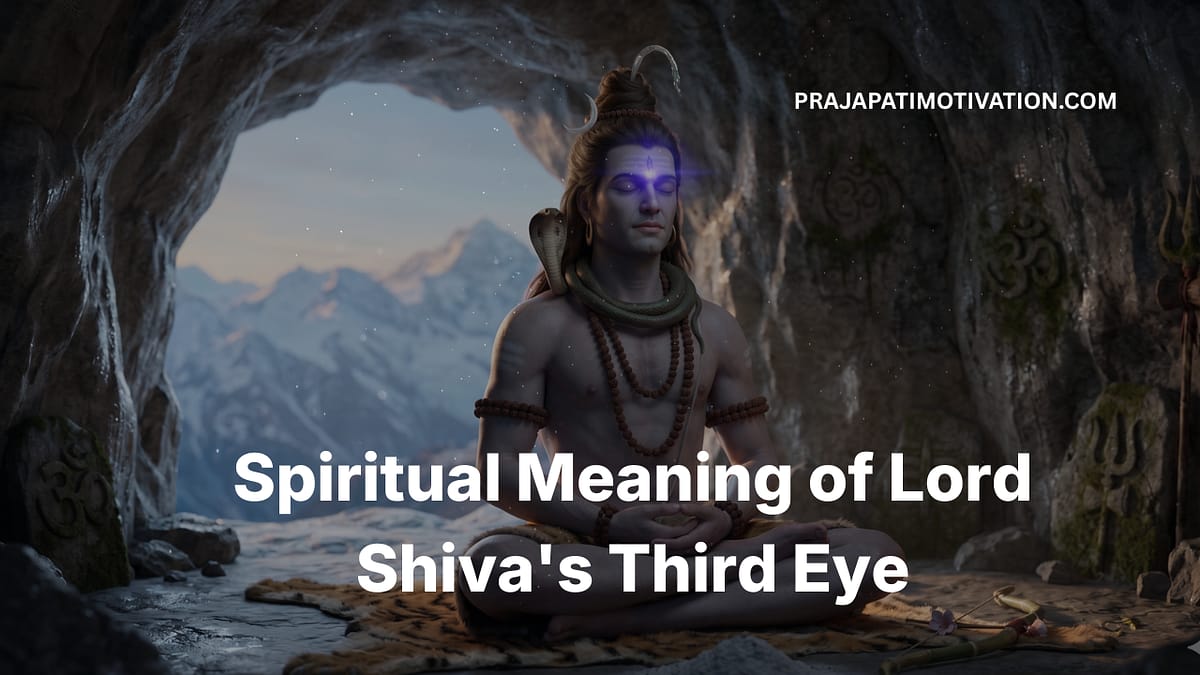
In modern yoga studios from New York to Moscow, the concept of the “third eye” is frequently discussed as the ultimate destination of deep meditation. However, long before it became a popular wellness buzzword in the West, the third eye was the defining attribute of Mahadeva—the Supreme Lord Shiva.
When you stand before the ancient basalt carvings of the Elephanta Caves off the coast of Mumbai, or walk the sacred grounds of the Trimbakeshwar Jyotirlinga in Maharashtra, the imagery of Shiva is striking. Amidst the serene expression and matted hair, the prominent vertical eye on his forehead commands immediate, profound attention. It is not merely a mythological physical trait; it is a profound map of human consciousness.
If you are on a spiritual journey, understanding the Spiritual Meaning of Lord Shiva’s Third Eye is the master key to moving beyond mere physical existence, overcoming daily anxieties, and unlocking your own higher state of being.
“We have two eyes to see the material world around us, but we require a third eye to perceive the infinite universe within us.
1.The Mythological Origin: The Burning of Kamadeva (Desire)
To truly grasp the symbolism, we must first dive into the ancient Puranic texts. Following the loss of his beloved first wife, Sati, Lord Shiva withdrew from the universe, entering a state of absolute, unshakeable meditation. The cosmos, however, needed his participation to maintain balance. The gods, desperate to break his trance so he could defeat the demon Tarakasura, sent Kamadeva—the Lord of Desire and Passion—to awaken him.
Kamadeva hid behind a tree and shot a mystical arrow of lust directly at Shiva’s heart. Disturbed from his cosmic meditation, Shiva did not react with his physical body. He did not yell or strike out. Instead, his third eye fiercely opened. A terrifying, blinding fire erupted from it, reducing Kamadeva to ashes in an instant.
While this may sound like a tale of destruction, the underlying meaning is deeply psychological. Kamadeva represents our base human desires, distractions, and ego. When Shiva opened his third eye, he demonstrated that higher cosmic awareness instantly burns away worldly lust and emotional turbulence.
Mahamrityunjaya Mantra Benefits
2.Triyambaka: The Deep Symbolism of the Three Eyes
In the ancient Vedic scriptures, Shiva is often referred to as Triyambaka, meaning “The Three-Eyed One” (a name famously chanted in the powerful Mahamrityunjaya Mantra). Each of his three eyes represents a fundamental force in the universe:
- The Right Eye (Surya/The Sun): Represents action, heat, logic, and the physical world. It governs our conscious activities.
- The Left Eye (Chandra/The Moon): Represents passivity, coolness, emotion, and intuition. It governs our subconscious and our feelings.
- The Third Eye (Agni/Fire): Represents the fire of transformation, supreme knowledge, and absolute truth.
The two physical eyes on our face are meant to navigate the material world. They see in duality: light and dark, good and bad, past and future, you and me. The third eye, however, transcends duality. It looks inward and sees the unified, eternal present.
3.The Eye of Wisdom (Jnana Chakshu) and the Destruction of Maya
In Hindu philosophy, the third eye is called the Jnana Chakshu, which translates directly to the “eye of absolute knowledge and wisdom.”
Our normal, physical eyes are easily fooled by illusions (Maya). For example, you might see a coiled rope in a dark room and mistakenly believe it is a snake. Your physical eyes send a message of fear to your brain, your heart rate spikes, and you suffer anxiety over something that isn’t even real. This is how we live most of our lives—reacting emotionally to illusions, false societal expectations, and misplaced fears.
The spiritual meaning of Lord Shiva’s third eye represents the ability to see things exactly as they are, stripping away the filters of human emotion, past trauma, and societal conditioning. When the eye of wisdom opens, ignorance (Avidya) is destroyed. You stop seeing yourself as just a physical body with a temporary job and temporary problems, and start recognizing the eternal, indestructible soul (Atman) within.
4.The Yogic and Scientific Connection: The Ajna Chakra
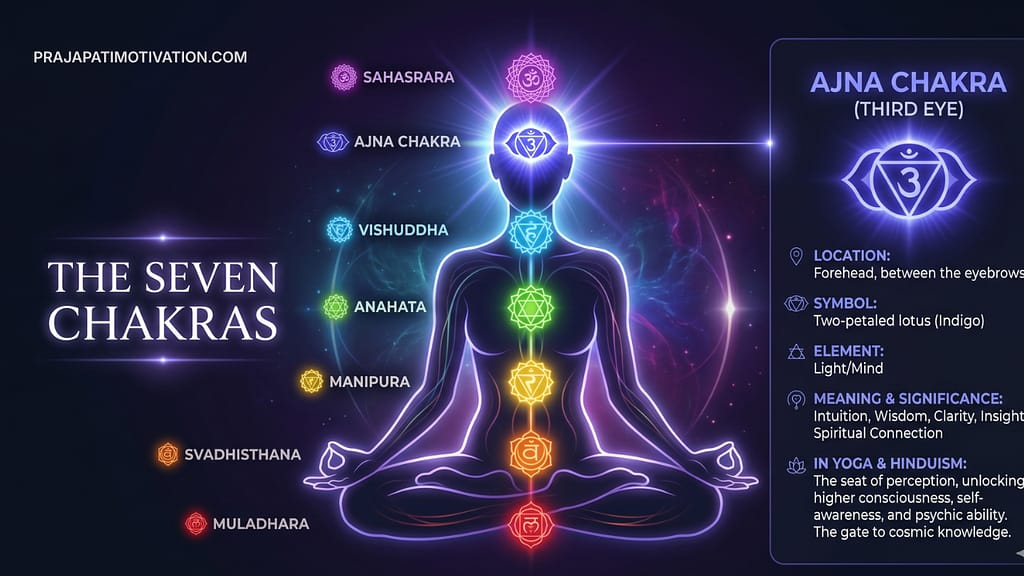
For seekers in the West practicing modern yoga or meditation, Lord Shiva’s third eye is not just a metaphor; it is directly connected to the subtle energy body system. Located precisely in the center of the forehead, between the eyebrows, this energy center is known as the Ajna Chakra.
In Sanskrit, Ajna translates to “command” or “perceive.”
The Biological Link: The Pineal Gland
Modern spiritual science often bridges ancient wisdom with biology by linking the Ajna Chakra to the pineal gland. This is a small, pea-shaped endocrine gland located deep in the center of the brain. Interestingly, the pineal gland contains light-sensitive cells—much like the retinas of our physical eyes—and regulates our circadian rhythms (sleep-wake cycles) by producing melatonin. When stimulated through deep meditation, practitioners often report a literal sensation of light and profound mental clarity.
The Spiritual Link
When Prana (life force energy) is directed upward from the base of the spine through dedicated yoga and breathing practices, it eventually reaches and activates the Ajna Chakra. A balanced and awakened Ajna Chakra grants the practitioner:
- Heightened intuition and foresight.
- Extreme mental clarity, banishing overthinking.
- A deep sense of inner peace that remains entirely unaffected by external chaos.
5.How to Cultivate and Awaken Your Own Inner Vision
The beauty of Hindu spiritual wisdom is that it is deeply democratic. You do not need to be an ascetic meditating in the snowy peaks of the Himalayas to tap into the power of the third eye. You possess this exact same inner architecture.
Here is how you can begin activating your Ajna Chakra through simple, consistent, daily practices:
1. Trataka (Yogic Gazing) This is an ancient purification practice. Light a candle in a dark, quiet room. Sit comfortably and stare gently at the brightest part of the flame without blinking, until your eyes naturally begin to water slightly. Then, close your eyes gently and focus purely on the glowing after-image of the flame right between your eyebrows. This trains the mind for singular focus (Dharana).
2. Chanting Om Namah Shivaya Sound carries profound energetic vibration. The primordial sound of Om specifically resonates with the frequency of the Ajna Chakra. Sit in silence, close your eyes, and slowly chant “Om Namah Shivaya.” As you do, direct your internal gaze to the center of your forehead. This helps draw your scattered, anxious energy inward.
3. The Practice of Mindful Detachment (Vairagya) Awakening the third eye is as much about psychological discipline as it is about meditation. Practice observing your own emotions without immediately reacting to them. When sudden anger, jealousy, or overwhelming desire arises (your own personal Kamadeva), take a breath. View the emotion logically as an observer rather than a participant. This conscious pause is the practical, real-world application of opening your eye of wisdom.
6. Conclusion: Moving from Sight to Vision
The spiritual meaning of Lord Shiva’s third eye is a beautiful, empowering reminder of human potential. We are not just flesh and bone meant to consume the material world, pay bills, and react to stress. We have the latent, divine architecture within us to perceive the infinite, understand the universe, and burn away our own suffering.
By taking the time to focus inward—whether through chanting, meditation, or simply observing our thoughts—we stop being victims of our external circumstances. We move from merely having sight to possessing true vision, becoming the masters of our own consciousness.
Frequently Asked Questions (FAQ)
What happens when Shiva opens his third eye?
In mythological stories, when Lord Shiva opens his third eye, it releases an intense, cosmic fire that destroys whatever it looks upon. Spiritually, this fire represents the brilliant light of supreme knowledge destroying the darkness of ignorance, ego, and worldly illusion.
Can normal humans open their third eye?
Yes. In Hinduism and Yogic traditions, every human being possesses an Ajna Chakra (the third eye energy center). It is awakened progressively through disciplined meditation, ethical living (Dharma), and consistent spiritual practice (Sadhana), leading to heightened intuition and peace.
What do the three lines of ash (Tripundra) on Shiva’s forehead mean?
The three horizontal lines of sacred ash (Bhasma or Vibhuti) drawn across Shiva’s forehead, passing over the third eye, symbolize the burning away of the three impurities: ego (Ahankara), ignorance (Avidya), and bad karma. It serves as a constant reminder to devotees of the temporary nature of the physical body.
Why is Lord Shiva called Mahadev?
Mahadev translates to “The Great God” or “Supreme Lord.” He is given this title because he represents the ultimate reality and the highest state of consciousness. He is the master of all elements, the conqueror of death, and the source of the universe’s destruction and recreation.