What Is Dharma in Hinduism?
In Hindu thought, dharma in Hinduism is one of the most profound and guiding principles. Beyond religion, rules or rituals, it points to the right way of living — in harmony with truth, society, and one’s own nature. When you ask “what is dharma in Hinduism,” you are opening to a wide spectrum: universal law, social ethics, personal responsibility. Let’s dive deeply.
1. Meaning & Dimensions of Dharma
Dharma in Hinduism unfolds across multiple layers; each layer offers a clearer view of how we are expected to live, act and align ourselves.
A. Cosmic Dharma (ṛta / Rta)
At the broadest level is cosmic dharma — ṛta — the underlying order that holds the universe together. In this sense, dharma in Hinduism is not just human duty but the very rhythm of being: night and day, seasons, birth and death. It’s the truth that reality abides by — the laws of nature and consciousness.
When human conduct aligns with this universal flow, peace and harmony arise. When it deviates — disorder, suffering and imbalance result.
B. Social Dharma (Sādhāraṇa Dharma)
Next comes social dharma — the ethical framework common to all humans. In Hindu teachings, dharma in Hinduism demands virtues like truthfulness (satya), non-violence (ahimsa), generosity (dāna), hospitality (atithi-satkara), and respect for life.
These are not abstract ideals: they govern how individuals behave in families, communities and nations. For example, social dharma means you don’t lie in business, you treat others with fairness, you protect the weak. When society follows this dharma, trust and goodwill flourish.
C. Individual Dharma (Svadharma)
Finally, there is individual dharma — svadharma — your personal duty rooted in who you are: your age, your role, your nature. In Hinduism, dharma in Hinduism recognizes that two people cannot live identically. Your dharma is unique to your circumstances.
For example, a student’s dharma is to study sincerely; a parent’s is to nurture a child responsibly; a warrior’s (in ancient times) was to protect the land. The Bhagavad Gita emphasizes this: it is better to fulfil one’s own dharma imperfectly than to perform another’s perfectly (BG 3.35).
When you act according to svadharma, you live authentically and contribute to the cosmic and social dharma.
Read More About Karma Yoga Explained
2. Why Dharma Matters: Real-Life Example (Following vs Not Following)
Example of following dharma:
Priya is a young teacher. Her role is to educate children. She stays honest, prepares lessons sincerely, treats every child with respect. Even when resources are scarce, she does her duty. Because she follows her svadharma — her personal role — and aligns with broader ethical values (truth, service) she creates a positive impact. Her life becomes meaningful, her work contributes to society.
Example of not following dharma:
Ramesh works in a company. He’s tempted to cut corners for profit. He ignores fairness, cheats a client. Over time, trust breaks, his conscience troubles him, the project fails. Here he has ignored his dharma — duty to be honest, to act with integrity. The result? Inner unrest, damaged reputation, ripple effects. This illustrates how ignoring dharma brings disorder personally and socially.
3. Key Teachings in Scripture
The texts of Hinduism — the Vedas, Upanishads, the great epics — treat dharma as central. For instance, the Bhagavad Gita frames Arjuna’s crisis around his svadharma (as a warrior) and asks him to act in alignment with it. Wikipedia+1
In classical scholarship, scholars note:
“Dharma … constitutes the inherent nature of a thing and involves a distinction between the inherent and the adventitious properties of a thing.”
That means: your dharma isn’t just what you want to do — it’s what you are meant to do given your nature, role, context. The Mahabharata says:
“Whenever dharma declines and adharma rises, then I manifest myself.” (Bhagavad Gita 4.7)
This shows that dharma sustains the world; ignoring it leads to chaos.
4. The Four Pillars of Dharma OR What are the 4 dharma in Hinduism? (Simplified & Deepened)
To live out your dharma in Hinduism, it helps to anchor your life on four pillars — each shaping your outer actions and inner attitude.
A. Righteous Duty (Kartavya)
This pillar asks: What do I need to do now, given who I am and where I stand?
Dharma in Hinduism asks us to act when duty calls — attend to the needy, uphold truth, defend justice. The righteous duty pillar reminds us that the world expects us to bear responsibility. When you move away from avoidance or escape, and step into duty with courage and integrity, you align with this pillar.
B. Ethical Means (Yukta)
It’s not enough to aim for a goal; how you reach it matters. In dharma in Hinduism, means matter as much as ends.
If your career, relationships or community work achieve outcomes by unfair means — manipulation, harm, deception — you violate dharma. The ethical means pillar is the inner compass saying: Walk the right path while pursuing purpose. This strengthens character and sustains long-term good.
C. Social Responsibility (Lokasaṃgraha)
Dharma in Hinduism is inherently social. The pillar of social responsibility means your actions ripple beyond yourself. Lokasaṃgraha (well-being of the world) shows that living dharma means caring for others, the environment and future generations.
When you volunteer, protect the weak, work for society’s betterment — you stand on this pillar. It transforms “me” into “we” and roots your individual dharma in collective welfare.
D. Spiritual Awareness (Ātman-jñāna)
Underneath every role, duty and relationship lies the inner Self — Ātman — the consciousness that is beyond body and mind. In dharma in Hinduism, the pillar of spiritual awareness invites you to remember: I am more than my tasks; I am beingness itself.
When you act with this awareness, the outward becomes the inward: cleaning a room becomes a meditation; working becomes worship; service becomes surrender. This pillar lifts the practice of dharma from duty to devotion.
Read More About Karma and Reincarnation in Hinduism
5. Contemporary Challenges to Dharma
In modern life, understanding and following dharma is harder. Temptations of instant gain, conflicting roles, blurred responsibilities… Example: A parent’s duty vs. a career ambition; a professional’s duty vs. market pressures.
When someone ignores dharma, we see burnout, broken relationships, loss of purpose. When someone aligns with dharma, even imperfectly, they feel grounded and their life ripples positively.
6. How to Discover Your Dharma in Everyday Life
Here are practical steps:
- Reflect: Who am I? What are my roles?
- Ask: Which action aligns with truth, contributes to others, and resonates with my nature?
- Act: Do the duty you see, even if imperfect.
- Review: At the end of each day ask: “Did my action reflect dharma or did I chase convenience/personal gain?”
- Adjust: Use each day as a chance to recalibrate toward dharma.
7. Dharma and Life’s Goals (Purusharthas)
In Hinduism, the entire journey of human life is beautifully mapped out through the concept of the four Purusharthas — the four aims or pillars of human existence. These are:
- Dharma (righteous duty and moral order)
- Artha (wealth and material prosperity)
- Kama (desire, pleasure, and emotional fulfillment)
- Moksha (liberation from the cycle of birth and death)
Among these, Dharma in Hinduism is considered the foundation — the root that supports the other three.
Without dharma, wealth (artha) can turn into greed.
Without dharma, desire (kama) can become indulgence and attachment.
Without dharma, even liberation (moksha) may become selfish or misguided.
In simple terms, dharma gives direction to human life. It ensures that our pursuit of money, pleasure, and freedom stays aligned with ethics, compassion, and inner balance.
A. Dharma: The Moral Compass
Dharma in Hinduism teaches that it is not wrong to earn money, enjoy life, or seek happiness — but it must be done in harmony with righteousness.
For example, a person earning wealth through honest work, helping others, and giving back to society is following artha within dharma. But one who earns through deceit violates the natural order — such wealth becomes a cause of inner unrest.
Similarly, enjoying life (kama) — through love, art, food, relationships — is sacred when guided by dharma. When pleasure turns into obsession or harm, we fall away from our true path.
B. The Balance Between the Four Goals
Ancient Hindu sages never taught renunciation as the only way; instead, they offered balance. Life was meant to be lived fully — to earn, to love, to grow, and finally to transcend.
But dharma must be the anchor. The Manusmriti and the Mahabharata both echo this truth: “Dharma protects those who protect dharma.” (धर्मो रक्षति रक्षितः — Dharmo rakṣati rakṣitaḥ)
Meaning, when you live a life rooted in dharma, that very righteousness safeguards you in return. It becomes your shield through challenges and confusions.
C. Real-Life Example
Think of King Janaka, father of Sita from the Ramayana. He ruled his kingdom, enjoyed royal comforts, yet remained detached and just. His wealth and pleasures were guided by dharma in Hinduism — he saw himself as a caretaker, not an owner.
In contrast, Ravana, though wise and powerful, allowed his desires to overrule dharma — leading to his downfall. Both lived within the same world, but only one lived according to dharma.
D. Dharma as the Thread of Life
When you see dharma in Hinduism as the golden thread, the other Purusharthas become beads on a necklace — shining beautifully but held together by dharma. If the thread breaks, everything else scatters.
In the end, the purpose of life is not to reject the world but to live righteously within it. Dharma teaches you how to walk that fine line — earning wealth, enjoying love, serving others, and finally, moving toward liberation with a pure heart.
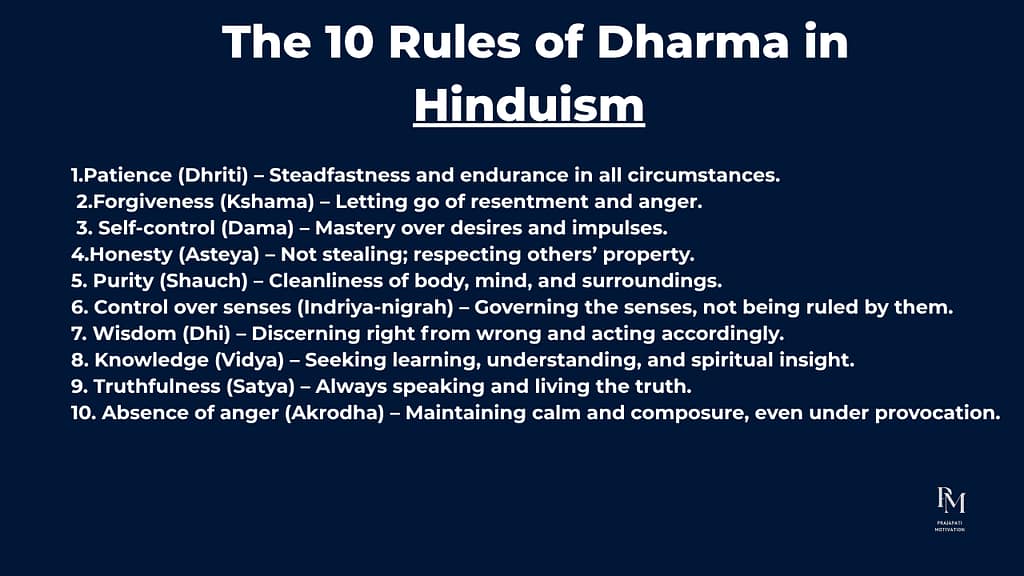
8. The 10 Rules of Dharma in Hinduism (Manusmriti’s Teachings)
According to Hindu philosophy, Dharma isn’t just about religion or rituals — it is a code of right living, a moral compass that guides how we think, act, and treat others.
The ancient sage Manu, in the Manusmriti (6.92), laid out ten timeless rules of Dharma — principles every person should strive to live by, regardless of age, caste, or background.
1. Dhriti (धृति) – Patience and Perseverance
“To remain steady even in difficulty.”
Dhriti means staying calm and patient when things don’t go your way.
Example: When you face setbacks at work or in relationships, instead of reacting impulsively, you stay composed and trust the process — that’s dhriti in action.
2. Kshama (क्षमा) – Forgiveness
“Forgive not because others deserve it, but because peace is your nature.”
Forgiveness releases you from hatred. Holding grudges only binds you to pain.
Example: Just as Lord Rama forgave Kaikeyi for sending him to exile, true dharma lies in forgiving and moving forward with compassion.
3. Dama (दम) – Self-Control
“Master your senses before they master you.”
Dama is the discipline to control your impulses — speech, desires, and actions.
Example: Avoiding gossip, unnecessary arguments, or indulgence in excess pleasures — that’s dama, a pillar of dharma in Hinduism.
4. Asteya (अस्तेय) – Non-Stealing
“Taking only what rightfully belongs to you.”
Asteya is not just about stealing objects — it includes not taking credit, time, or recognition that isn’t yours.
Example: Being honest about your work instead of claiming someone else’s effort is living asteya.
5. Shauch (शौच) – Purity (Inner & Outer)
“Cleanliness of body, mind, and intention.”
Shauch teaches that purity is both physical and mental.
Example: Taking care of hygiene, keeping your thoughts free from jealousy or hatred, and maintaining a clean living space — all reflect shauch.
6. Indriya-Nigrah (इन्द्रिय-निग्रह) – Control over the Senses
“The senses are powerful; direct them wisely.”
It’s about managing the attraction toward pleasure and distraction.
Example: Resisting the temptation of overindulgence — whether in food, social media, or anger — shows mastery over senses.
7. Dhi (धी) – Wisdom and Intellect
“Right understanding that guides right action.”
Dhi is the ability to think clearly, discriminate between right and wrong, and make wise decisions.
Example: Like Arjuna seeking Krishna’s guidance before the battle, we too must pause and reflect before acting.
8. Vidya (विद्या) – Knowledge
“True knowledge leads to humility and service.”
Vidya is not just book learning — it’s awareness of truth and reality.
Example: A truly educated person uses their knowledge for the good of others, not arrogance — this is vidya guided by dharma.
9. Satya (सत्य) – Truthfulness
“Speak the truth, but speak it kindly.”
Satya is central to dharma in Hinduism. It means honesty in thought, speech, and behavior.
Example: Mahatma Gandhi made Satya (Truth) the foundation of his life and politics — that’s dharma in its purest form.
10. Akrodha (अक्रोध) – Freedom from Anger
“Anger clouds the mind; peace reveals wisdom.”
Akrodha means not letting anger control you.
Example: When insulted or criticized, you choose calm over rage. Krishna advises Arjuna that uncontrolled anger leads to delusion — and delusion destroys wisdom.
9. Summary & Final Reflection
So, dharma in Hinduism is not a rigid command but a living principle — it asks you: “How can I live right here, right now, given who I am and the world around me?” When you act with awareness, responsibility, alignment with truth, you live dharma. When you ignore it, life’s harmony falters.
May your journey be anchored in dharma — and may your actions reflect this timeless truth.
10. FAQs About the Dharma in Hinduism
1. What is the true meaning of Dharma in Hinduism?
In Hinduism, Dharma means the moral order, righteous duty, and path of truth that upholds life and the universe. It’s about living in harmony with your inner values, performing your responsibilities with honesty, and contributing to the balance of the world.
2. How is Dharma different from religion?
While often translated as “religion,” Dharma goes far beyond rituals or belief systems. It is a way of life — the universal law of truth, morality, and duty that governs both nature and human behavior. Every person, regardless of religion, has a Dharma — a personal code of righteousness.
3. What are the 10 rules of Dharma?
The Manusmriti lists ten universal principles of Dharma:
Patience (Dhriti), Forgiveness (Kshama), Self-control (Dama), Honesty (Asteya), Purity (Shauch), Control over senses (Indriya-nigrah), Wisdom (Dhi), Knowledge (Vidya), Truthfulness (Satya), and Absence of anger (Akrodha).
Together, they guide a person toward a balanced and ethical life.
4. What is the connection between Karma and Dharma?
Dharma tells you what you should do, while Karma reflects the results of what you actually do.
When you follow your Dharma, you create good karma. But when you act against your moral duty, you create bad karma — which influences your future experiences in this life and the next.
5. How does reincarnation relate to Karma?
According to Hindu belief, every soul (Atman) undergoes multiple births and deaths — a cycle known as Samsara.
Your Karma (actions) in one life determine your next birth. Living righteously, following Dharma, and reducing attachment to material desires help the soul move closer to Moksha — liberation from the cycle of rebirth.
6. What are the four types of Dharma?
Hindu philosophy mentions four types of Dharma:
- Sanatana Dharma – the eternal cosmic law of truth and righteousness.
- Varnashrama Dharma – duties based on one’s stage and role in life.
- Svadharma – one’s personal duty according to their nature and purpose.
- Sadharana Dharma – universal duties like honesty, compassion, and non-violence.
7. Can a person’s Dharma change over time?
Yes. Dharma evolves as you move through different stages of life (Ashramas) or take on new responsibilities. For example, a student’s Dharma focuses on learning, while a parent’s Dharma involves protection, care, and guidance. True Dharma adapts to time, place, and situation — always rooted in righteousness.
8. What happens if someone doesn’t follow their Dharma?
Ignoring one’s Dharma creates inner conflict and negative karma. In the Bhagavad Gita, Lord Krishna explains that acting against your true duty leads to suffering and imbalance — both within the self and in society. Living by Dharma restores peace and spiritual clarity.







2 thoughts on “What Is Dharma in Hinduism?”