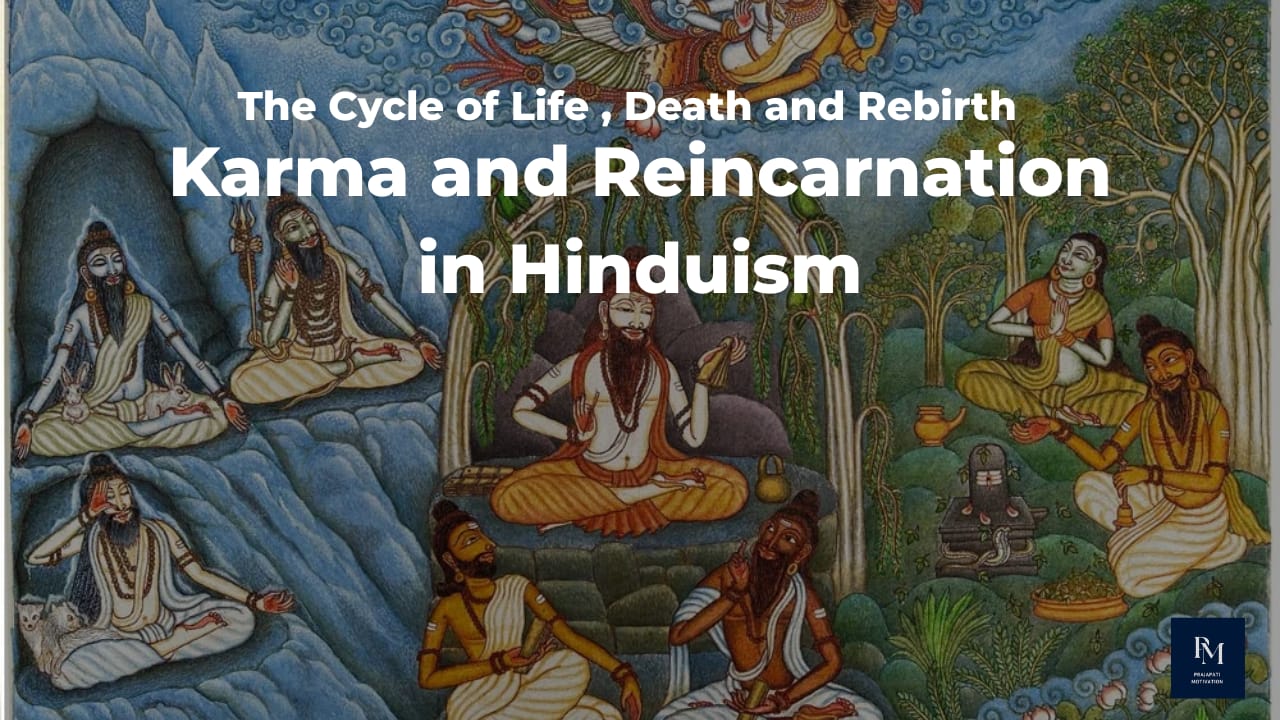
In Hindu philosophy, the twin principles of karma and reincarnation (कर्म और पुनर्जन्म) form the core framework through which life, death, and rebirth are understood. To live wisely, we must understand what happens when we act, and what happens when we are reborn. This article explores these concepts clearly, deeply, and practically
What Does Hinduism Teach About Karma and Reincarnation (कर्म और पुनर्जन्म)?
In Hindu philosophy, the twin principles of karma and reincarnation (कर्म और पुनर्जन्म) form the spiritual backbone of how life, death, and rebirth are understood. To live wisely, we must understand what happens when we act — and what happens when we are reborn.
This article explains karma and reincarnation in Hinduism clearly, deeply, and practically, with relatable examples and scriptural insights.
1. What is karma (कर्म)? — simple, a little deeper, and a real-life example
Short simple definition:
Karma (कर्म) literally means “action.” In Hindu thought, karma is more than just what you do — it includes your intention, the energy behind the action, and the results that follow. Put simply: karma = action + consequence.
Go a little deeper (still simple):
Every choice you make — a kind word, a careless remark, a daily routine — leaves an imprint in your character and life. Those imprints shape future situations. So karma is not punishment or reward handed down by a judge; it is the natural outcome of causes you have sown. In this way, karma is like gardening: plant seeds (actions) and later you harvest consequences (results). Over time, repeated actions form tendencies (संस्कार, samskāra) that make certain outcomes more likely.
Let’s Understand Karma from Real-life example (warm, relatable):
Imagine Riya, who works in an office. Every day she helps a new colleague learn the software without showing frustration. She does this sincerely, expecting nothing in return. Over months, people remember her as helpful and trustworthy. Later, when Riya needs a recommendation or support, those same colleagues help her. Her habit of helping created real, positive results. That is karma in human terms: actions (helping) → impressions (reputation, trust) → outcomes (support when needed).
Why this matters:
Understanding karma helps you see that small daily choices matter. You don’t need dramatic change overnight—consistent small kindnesses and honest work change your life’s direction.
Read About Spiritualism in Hinduism
2. What is reincarnation (पुनर्जन्म)? — clear, deeper, and a real-life example
Short simple definition:
Reincarnation (पुनर्जन्म) is the idea that the individual soul (Ātman) continues beyond one physical life and takes on new forms or bodies until it matures spiritually. The process is commonly described as the cycle of birth, death, and rebirth (संसार, saṃsāra).
Going little deeper in reincarnation (still simple):
Reincarnation is not about randomly leaping into another life. According to Hindu understanding, the conditions of each new birth are shaped by past tendencies and unfinished lessons — the cumulative karma of the soul. Think of life not as a single test but as a school: each life offers opportunities (and consequences) that help the soul learn and grow. Over many lives, the soul learns, purifies, and eventually reaches freedom (moksha, मोक्ष), where the cycle of rebirth ends.
Let’s Understand reincarnation from Real-life example (relatable):
Consider a person, Mohan, who as a child was repeatedly afraid of public speaking. In many small choices (avoiding presentations, not practicing), the fear strengthened. Offering a reincarnation-style analogy: imagine Mohan’s fear as a “karmic seed.” If he never addresses it, that tendency may repeat as a similar life-challenge in another life. But if Mohan decides to confront his fear—joins a club, practices speaking—he changes the pattern. In reincarnation terms, addressing tendencies in one life can reduce similar problems in future lifetimes.
Why this matters:
Reincarnation gives a longer view: life’s difficulties aren’t always “unfair”; they are opportunities for learning across time. This perspective can create patience and a willingness to work on inner habits.
3. Karma and reincarnation in the Upanishads & Vedas — explained with a scriptural example
Context first (simple):
The Vedas are the oldest layers of Hindu scripture. The Upanishads (उपनिषद्), appended to the Vedas, move from ritual to inner wisdom — they ask: Who am I? What is reality? The Upanishads are the primary place where ideas about the eternal Self (Ātman), the Universal (Brahman), and the law of karma and reincarnation are explained philosophically.
Key teaching from the Upanishads (in simple words):
The Upanishads describe the soul as eternal and say that the body is like clothing: when old clothing is discarded, new clothing is worn. Likewise, at death the soul leaves one body and takes another. The moral quality of past actions influences what kind of “clothing” (body and life) the soul will take next. This is the essential scriptural picture of karma and reincarnation.
Scriptural example (clear and human):
The Bṛhadāraṇyaka Upanishad uses stories and analogies to explain rebirth and the continuity of the Self. One commonly cited image (paraphrased simply) is of a person who, like a traveler, takes a new garment. Similarly, the soul, after death, “puts on” a new body according to previously sown impressions. The Chandogya Upanishad also contains teachings that point to the unity of Atman and Brahman and implicitly supports the idea that the soul is continuous and subject to moral cause and effect.
A short epic illustration (Ramayana/Mahabharata connection):
The Mahabharata—and particularly the Bhagavad Gita within it—explains reincarnation in a human-register verse: the body dies, but the soul does not; it takes another body. Krishna tells Arjuna that the self passes through births and deaths (Gita 2.22). This passage ties the philosophical Upanishadic insight to practical guidance: act rightly (karma yoga) without attachment, because action and its quality shape future births.
Why this matters:
When scripture teaches karma and reincarnation, it is not giving cold doctrine: it is offering a tool for moral responsibility, inner growth, and hope. The Upanishads and Gita guide the seeker: know the Self, act rightly, and free yourself from repeating patterns.
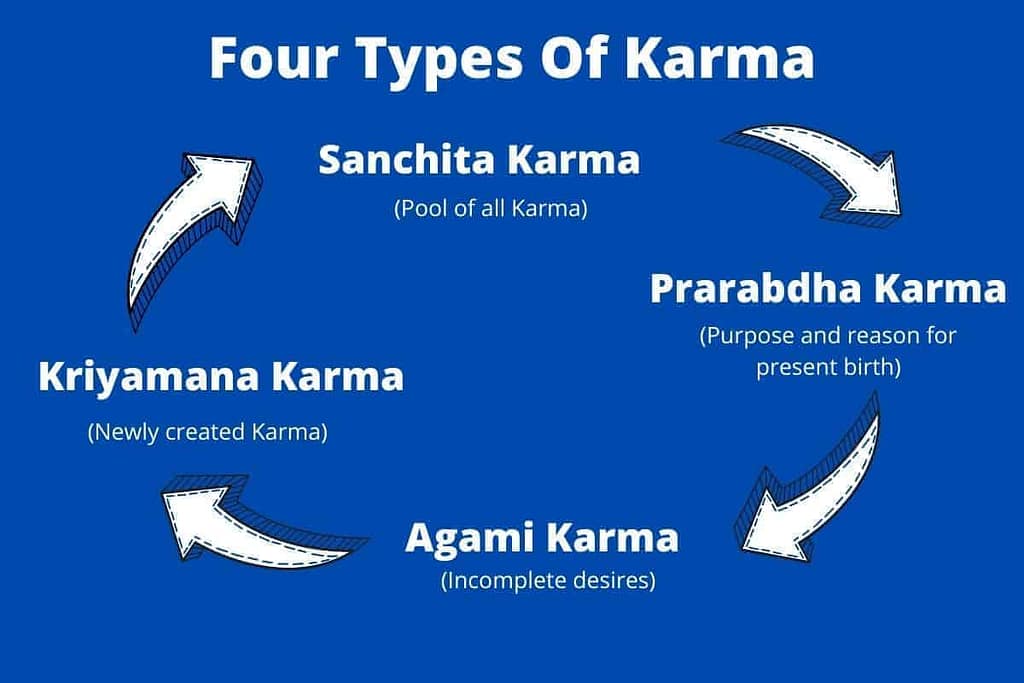
4. Types of karma — brief details and real-life human examples (we’ll make a full post later)
Hindu thought distinguishes different layers of karma. Here are the main categories explained simply, with human examples so they feel real.
a. Sanchita Karma (संचित कर्म) — accumulated store of past results
What it is: All the karma accumulated over many past lives (and this life), stored like a reservoir.
Example: Priya has unexplained tendencies—strong empathy or recurring health issues—that feel like long-term patterns. Those can be viewed as part of her sanchita karma, a background store influencing life circumstances.
b. Prarabdha Karma (प्रारब्ध कर्म) — the portion being experienced now
What it is: A slice of the sanchita that has ripened into the present life; it determines the broad circumstances of birth and major life events.
Example: Rahul is born into a family facing poverty and early hardship. In human terms, this is similar to prarabdha karma—the set of conditions he is currently working through; his present life’s major lessons and situations.
c. Agami Karma (आगामी कर्म) — karma created by present actions that will bear fruit later
What it is: New karma being generated right now; these will shape future situations or lives.
Example: If Meera cheats on an exam, that dishonest act creates agami karma—tendencies and consequences that will influence her future choices and experiences.
d. Kriyamana / Itself-called (क्रियमान / वर्तमान कर्म) — immediate action and its instant results
What it is: The karma you create and experience almost immediately in this life (sometimes used interchangeably with agami).
Example: If a driver helps a stranded commuter today, the immediate goodwill, the grateful response, or the social favor returned the next week is part of kriyamana effects.
Short note on interaction:
Sanchita is the store, prarabdha is the slice being experienced now, and agami/kriyamana are new seeds you plant. Understanding these types shows why changing your habits matters: you can influence future ripening by the choices you make now.
Short summary:
- Sanchita = stored karma
- Prarabdha = karma you’re living now
- Agami/Kriyamana = karma you’re creating
By understanding these, you realize — you can’t always change your past, but you can shape your future karma through mindful action today.
5. Hinduism teachings on karma and reincarnation was first presented?
The Hindu teachings on karma and reincarnation were first presented in the ancient Vedas and later expanded in the Upanishads — the sacred texts of Hinduism.
1. Origin in the Vedas
The Vedas (written around 1500–1200 BCE) are the oldest spiritual scriptures of Hinduism.
In the Rigveda, there are early references to how a person’s actions (karma) affect their destiny. However, the idea of reincarnation (rebirth) wasn’t deeply explained there — it was only hinted at through hymns that talk about life, death, and renewal.
2. Explained in the Upanishads
The Upanishads (around 800–500 BCE) gave the first detailed explanation of both karma and reincarnation.
They taught that:
- Every action (karma) has consequences — good actions lead to good results, bad actions to suffering.
- The soul (Atman) is eternal and, after death, it takes on a new body based on the accumulated karma.
- The ultimate goal is moksha — liberation from this cycle of birth and death (samsara).
3. Example to Understand
Imagine your life as a classroom and each birth as a new grade.
If you study well (do good karma), you move to a higher grade with better opportunities.
If you fail or cheat (bad karma), you repeat the grade or face harder lessons next time.
When you finally master all lessons (reach spiritual understanding), you graduate — that’s moksha.
Final Reflection
In Hinduism, the teachings of karma and reincarnation remind us that life is not random — it’s a journey of the soul learning through experience. Each thought, word, and deed writes the next chapter of that journey.
Act wisely, live kindly, and remember: your present is the seed of your future.
FAQs on Karma and Reincarnation in Hinduism
1. How does karma affect reincarnation?
In Hinduism, karma directly determines the conditions of your next life. Every action — good or bad — creates karmic energy that shapes your future experiences. If you live with honesty, compassion, and selflessness, you are likely to be reborn into better circumstances. But negative actions, such as greed or cruelty, lead to a more challenging rebirth, giving you a chance to learn and correct past mistakes.
2. How does karma affect rebirth?
Karma acts like a spiritual law of cause and effect. At the time of death, your accumulated karma (called Sanchita Karma) decides where your soul goes next. Good deeds bring positive results and a more favorable rebirth, while bad deeds bring hardship. This cycle continues until the soul achieves spiritual liberation (moksha), ending the need for rebirth.
3. What is the karmic cycle of reincarnation?
The karmic cycle, or Samsara, is the continuous loop of birth, death, and rebirth. The soul (Atman) carries its karma from one life to another, learning through experiences. Each birth is an opportunity to cleanse past karma through right action, devotion, and knowledge. Once the soul becomes pure and detached, it breaks free from the cycle and merges with the Divine.
4. Who is the god of karma in Hinduism?
In Hinduism, Lord Shani (Saturn) is often regarded as the God of Karma because he delivers the results of one’s actions — both rewards and punishments — with complete fairness. However, Lord Yama, the God of Death, also plays a role in judging souls after death and determining their next birth based on karma. Both ensure the divine balance of justice in the karmic system.
5. What are the three types of karma in Hinduism?
There are three types of karma:
- Sanchita Karma: The total collection of all past karmas.
- Prarabdha Karma: The portion of karma being experienced in this lifetime.
- Kriyamana (Agami) Karma: The karma we are currently creating through our present actions.
Each one influences your destiny and shapes future reincarnations.
6. Can karma be changed or erased?
Yes — karma can be transformed through selfless actions (Seva), devotion (Bhakti), meditation (Dhyana), and spiritual wisdom (Jnana). When a person realizes the divine nature of the soul and acts without selfish desires, old karmic debts begin to dissolve. True understanding and inner purity can lighten the karmic burden.
7. How can one break free from the karmic cycle of rebirth?
Freedom from the karmic cycle (moksha) is achieved through self-realization — understanding that the soul (Atman) is one with the Supreme (Brahman). Living a life of truth, compassion, and detachment helps dissolve karma. The Bhagavad Gita teaches that performing one’s duty without attachment to results leads the soul toward ultimate liberation.
8. What do karma and reincarnation mean?
In Hinduism, karma (कर्म) means action — every thought, word, or deed that carries an energy which returns to us as results. Reincarnation (पुनर्जन्म) means rebirth — the belief that the soul (Atman) lives many lives, taking new forms based on past karma. Together, they explain how life’s circumstances are not random but shaped by our actions across lifetimes.
9. What is the relationship between karma and reincarnation?
Karma and reincarnation are deeply connected. Karma determines the quality of your next life, while reincarnation is the process that allows karma to unfold. In other words, reincarnation is the stage, and karma is the script. The soul is reborn to experience the results of its past actions — learning, evolving, and moving closer to liberation (moksha).







9 thoughts on “Karma and Reincarnation in Hinduism”